
I was not born into a world that explained ambition through startups, valuations, pitch decks, or product roadmaps.
I was born in Naya Gaun of Sangachok, in Sindhupalchok, into a low-middle-income family where education was not assumed. It was earned. It was protected. It was treated almost like a family vow.
My parents did not get the chance to continue their own education the way they may have wanted. Like many Nepali parents, they did not turn that unfinished dream into complaint. They turned it into sacrifice. They placed the incomplete part of their own journey inside their children and hoped we would carry it further.
So when I say I believe in learning, I do not mean it as a motivational sentence. I mean it as inheritance.
In Sanskrit, vidyā means knowledge, learning, and illumination. But in the world I come from, knowledge was never meant to stand alone. It had to become charitra, character. It had to become sevā, service. It had to make a person more responsible, more useful, and more honest with the world.
That belief shaped me before I had the language to explain it.#
During my SEE preparation, there were nights when electricity was not available. I studied under torchlight. At that time, it did not feel like a story. It felt normal. Many Nepali students know that kind of normal. You adjust around power cuts, limited resources, family pressure, and the quiet fear of not knowing whether effort will be enough.
Only later did I understand what those nights were teaching me.
They were not teaching me suffering. They were teaching me adaptation.
Sindhupalchok understands adaptation deeply. It is a district shaped by movement, hardship, migration, and rebuilding. After the earthquake of April 25, 2015, Sindhupalchok became one of Nepal’s worst-affected districts. For people from places like mine, resilience is not a word for speeches. It is something families practice without applause.
That is why I do not see my journey as an individual achievement alone. I see it as part of a longer Nepali habit. We rebuild. We adjust. We carry memory forward. We keep moving before the road is complete.
In 2018, I left home for higher education. I carried ambition, but I also carried fear. Would I belong? Would I manage? Would I be able to stand among students from different backgrounds? Would I justify the sacrifices made for me?
Education did not happen in isolation. It happened alongside pressure. Like many young Nepalis, I had to learn while also thinking about work, family, money, and the future. The polished version of success often removes this part. But for many of us, becoming capable means learning while already carrying responsibility.
Support from Samaanta Foundation became one of the turning points in my life. It helped me continue through plus two and bachelor-level education. For many students like me, the first real capital is not money in a bank. It is access. Access to education. Access to people who believe you are worth investing in. Access to a room where your background does not decide your ceiling.
There is a difference between talent and opportunity.#
Nepal has never lacked the first. It has struggled to distribute the second.
Later, I graduated from Tribhuvan University, one of Nepal’s largest and most important academic institutions. I was also shaped by Thames International College, one of Nepal’s rare liberal education environments, where learning was not only about passing exams but also about questioning, reflecting, and preparing for complexity.
That mattered to me.
Because I believe Nepali minds deserve a higher stake in the world’s think tanks, research rooms, digital institutions, policy tables, and boardrooms. Not because we are entitled to it, but because we come from a civilization that has spent thousands of years thinking about life, duty, impermanence, devotion, discipline, consciousness, community, and continuity.
We do not need to borrow depth from elsewhere.
We need to translate our depth into the language of today.
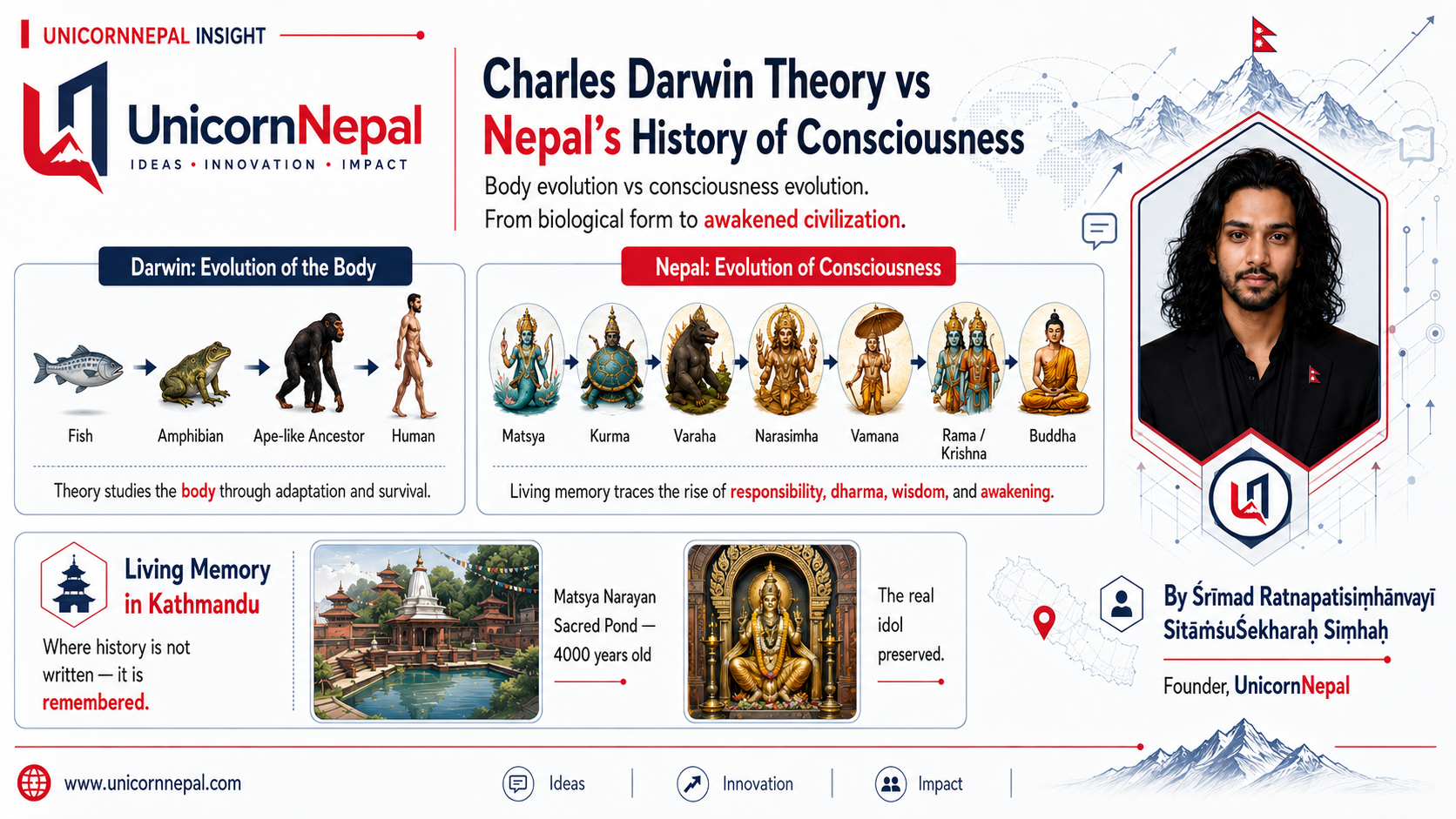
Sanātana means eternal, continuous, that which carries forward without losing its essence. Dharma comes from the Sanskrit root dhṛ, to hold, sustain, or support. Together, Sanatan Dharma is not only a religious phrase. It is a civilizational way of understanding continuity, duty, balance, and responsibility.
Nepal’s Sanatan inheritance is not a frozen identity. It is a living continuity.#
The Kathmandu Valley has been carrying that continuity for centuries. The Licchavi period, often dated from around 450 CE to 750 CE, gave the Valley early forms of statecraft, art, inscription, temple culture, and religious synthesis. Swayambhunath is believed to date back to 460 CE, with King Manadeva associated with its construction, and by the 13th century it had become an important center of Buddhism.
From the 7th century, the memory of Rato Machindranath, King Narendra Deva, drought, Gorakhnath, and the return of rain lives in the Valley’s ritual imagination. Whether one reads it as history, oral memory, or sacred metaphor, the meaning is clear: the Valley learned to organize crisis through community, movement, devotion, and public ritual.
By the 10th century, Indra Jatra was associated with King Gunakamadeva and the founding memory of Kathmandu. Its Neva name, Yenya Punhi, still carries the sound of a city that refuses to forget itself. The festival brings together devotion, masked dances, Kumari tradition, remembrance of ancestors, the end of monsoon, and the rhythm of Kathmandu itself.
From 1201 to 1779, the Malla period shaped much of what the world now recognizes as the Kathmandu Valley’s cultural brilliance with Fusion of Tirhut Civilizational Memory which gave rise to temples, courtyards, palaces, festivals, urban systems, sculpture, manuscript culture, and public ritual flourished under that long medieval arc.
In the 14th century, Jayasthiti Malla became associated with legal and social reforms, showing that Nepal’s historical imagination was not only ritualistic but institutional. It was concerned with law, social order, civic responsibility, and the organization of life.
From 1428 to 1482, Yaksha Malla ruled the united Kathmandu Valley before its later division among his sons. That division eventually produced the city-state brilliance of Kantipur, Lalitpur, Bhaktapur, and Banepa, each contributing to the cultural density of Nepal Mandala.
From 1641 to 1674, Pratap Malla’s reign in Kantipur became one of the high points of art, literature, architecture, and religious patronage. In 1670, Rani Pokhari, or Nhu Pukhu, was built, carrying memory, grief, water, devotion, and public architecture into one urban form.
These dates matter to me because they show that Nepal did not begin with scarcity.#
Before we were called poor by modern economic language, we were already building systems of time, water, law, ritual, language, art, trade, devotion, and public memory.
The word Neva is not just a social label. It carries the memory of Nepal Mandala, of Nepal Bhasa, of people who carried Sanskritic and local knowledge systems into daily life. The surname Shrestha comes from Sanskrit śreṣṭha, meaning excellent, eminent, distinguished, or foremost. I do not carry that as ego. I carry it as a reminder that a name can become a responsibility if one is willing to live with discipline.
When I look at my own lineage, I do not see only family history.
I see continuity.#
From stories passed down by elders, I have heard how our communities carried rituals, festivals, and practices across generations. Machindranath Jatra, Indra Jatra, and countless Neva traditions are not merely cultural events. They are living systems of memory.
Some of our traditions are said to carry roots from Bajrayāna, from Narayan Sampradaya, from Nath Sampradaya, and from older Sanatan streams that shaped the Valley. Family stories also speak of Haṭha Yoga and its links to Neva communities of Bhaktapur, Kathmandu, and Lalitpur. I do not claim every oral memory as academic fact. But I respect oral memory as one way a civilization preserves what formal records often fail to hold.
Then came the political remaking of Nepal.#
In 1743, Prithvi Narayan Shah began the unification campaign that would reshape the Himalayan region. In 1768, after taking Kathmandu, he announced the creation of the Kingdom of Nepal and moved the capital from Gorkha to the Kathmandu Valley. In 1769, Bhaktapur fell, completing the conquest of the Valley.
Those dates still matter because they changed the idea of Nepal from a Valley-centered civilizational space into a larger political state.
By the 19th century, the courage of Gorkha had begun entering the global imagination through military service far beyond the hills. By 1814 to 1816, the Anglo-Nepalese War had brought Nepal face to face with British imperial power. In 1816, the Treaty of Sugauli redrew borders and shaped Nepal’s modern geopolitical limits.
In 1934, the Nepal-British Empire (Present India) earthquake damaged parts of Kathmandu Valley, reminding the country that memory survives only when each generation rebuilds what the last generation leaves behind.
On May 29, 1953, Tenzing Norgay and Edmund Hillary reached the summit of Sagarmatha, Mount Everest, turning Nepal into a symbol of humanity’s reach toward the highest point on Earth.
In 1959 and 1960, another kind of Himalayan story entered the shadows: Kalpa Vigraha.
The Kalpa Vigraha is a legendary bronze idol of Lord Shiva that internet lore claims to be over 28,000 years old. However, this age is highly disputed. Radiocarbon (C-14) dating tests were only conducted on the wooden chest it was kept in, not the metal idol itself
Kalpa in Sanskrit refers to an immense cycle of cosmic time. Vigraha means form, embodiment, image, or sacred form. Together, Kalpa Vigraha can be understood as “the form of time,” or “an embodiment from an age beyond ordinary memory.”
Why it matters?
It matters because it points to a larger wound.#
Mustang has never been empty land between empires. It has been a corridor of trade, pilgrimage, monastic movement, Sanatan memory, Tibetan Migration practice, geopolitical struggle, and Himalayan knowledge. Muktinath, in Mustang, is sacred to both Sanatan traditions since the age of Satya Yuga. Its Sanskrit meaning can be read as “lord of liberation,” from mukti, liberation, and nātha, lord or protector.
So whether Kalpa Vigraha is ever publicly verified or not, the deeper question remains.
How many objects, manuscripts, rituals, oral histories, and knowledge systems from this region have disappeared into private collections, foreign archives, intelligence files, sealed rooms, or simply silence?
That is why I see Kalpa Vigraha not as a claim to be shouted, but as a wound to be understood.
It represents the part of our civilization that may be hidden, contested, classified, dismissed, or lost because it does not fit the world’s accepted timeline. It reminds me that Nepal’s ancient story is not only preserved in temples and festivals. Some of it may be scattered. Some of it may be buried. Some of it may be locked away. Some of it may survive only as whispers passed from one generation to another.
Then came modern political rupture.#
On June 1, 2001, the royal massacre shook Nepal’s moral and political imagination. On November 21, 2006, the Comprehensive Peace Agreement formally ended the decade-long conflict and opened a new political chapter. On May 28, 2008, Nepal abolished the monarchy and became a federal democratic republic.
These were not only political dates. They were civilizational shocks. They forced Nepal to ask what continuity means when old institutions collapse, when new institutions are still fragile, and when young people inherit both memory and uncertainty.
By 2023, the World Bank was already speaking of Nepal’s connection to the global digital economy, IT services exports, and a growing startup landscape. By 2025, Nepal was celebrating the 72nd anniversary of the first Everest ascent, while Kami Rita Sherpa’s record 31st ascent reminded the world that Nepali excellence is not only historical; it is still being renewed.
This is the world I am building inside.
Not a world where Nepal is waiting to prove it exists.
A world where Nepal must decide what form its next contribution will take.
So for me, the question is not whether Nepal can build.
That question belongs to people who have not been paying attention.
This is a country that carried living traditions for more than a thousand years without turning them into museum pieces. This is a country where chariot festivals still move through ancient city streets, where language, ritual, devotion, trade, and community memory have survived monarchy, republic, earthquake, migration, and modern distraction.
This is a country whose people reached the highest point on Earth when the Himalayas still represented the edge of human possibility. This is a country whose courage has been spoken about in distant battlefields, whose patience has lived in temples, courtyards, monasteries, workshops, farms, and family homes.
We have already built continuity.
We have already carried courage.
We have already shown what human will can reach.
The question now is different.
In a world increasingly shaped by systems, software, data, and institutions, what will Nepal’s story be?
Will we remain known mainly for the people we send out, the mountains others come to climb, and the traditions others come to photograph?
Or will we also become known for the systems we create, the knowledge we organize, the institutions we build, and the digital products that carry our intelligence into the world?
For me, that is the real challenge of this age.
Not to prove that Nepal can build.
But to decide what Nepal must build next.#
My entrepreneurial journey began humbly, not with certainty, but with curiosity and responsibility. As a co-founder and active R&D member at HIDDENLAYER NETWORK, I wear multiple hats across the solutions we are building. But I do not believe real recognition lies in the credit we take. I believe it lies in the impact our work creates.
I am still learning what it means to build seriously.
Learning, for me, is not a phase before work. Learning is the work. Self-learning may be the most honest form of learning because it does not reward what you say you know. It reveals what you can understand, test, repair, and improve.
The deeper I go into building business solutions, the more revealing the experience becomes. Real problems rarely arrive cleanly. They come mixed with human habits, operational gaps, unclear ownership, fragmented data, and decisions made under pressure. Technology becomes useful only when it respects that complexity.
That is why I do not want to build digital products that simply look intelligent from the outside. I want to help build systems that are human-centric, tied to profit and loss, adaptive to real workflows, and capable of turning business-owned data into intelligent, tested, actionable growth.
Businesses already own a lot of truth. It lives in their operations, customer conversations, sales records, support logs, financial patterns, missed opportunities, and repeated mistakes. The problem is that most of this truth is scattered. It is not organized into decisions.
That is where technology should serve.
Not by replacing people for the sake of efficiency. Not by creating dashboards that decorate confusion. Not by automating work without understanding context. The purpose should be clarity. Better decisions. Less waste. Stronger accountability. More intelligent workflows. Growth that comes from tested data rather than guesswork.
The world is full of tools. The harder task is building trust.
Globally, the digital economy has already changed power. Silicon Valley turned software into scale. Shenzhen turned manufacturing into speed. Bangalore turned technical talent into global service infrastructure. Artificial intelligence is now reshaping how companies think about work, knowledge, decision-making, and productivity.
Nepal entered this race with constraints. Limited capital. Limited mentorship. A smaller domestic market. Social pressure toward safer careers. A long history of exporting labor, students, and skilled people because opportunity at home often felt too narrow.
But I do not believe Nepal lacks ambition. I do not believe Nepal lacks intelligence.
I believe Nepal has often lacked systems strong enough to organize its ambition.
For decades, one of our strongest exports has been people. Remittance has carried families, educated children, rebuilt homes, and held the economy together. I respect that sacrifice deeply. But I also hope we can build a future where leaving is a choice, not the only path to dignity.
That is why the digital world matters to me.
If we build well, technology can allow Nepali talent to remain rooted while working at global standards. It can help businesses become more efficient. It can create jobs that do not require every capable young person to leave. It can help Nepal move from consuming systems to creating them.
But this will not happen through noise.
It will not happen through exaggerated founder stories.
It will not happen by pretending every early project is already a revolution.
It will happen through discipline.
It will happen when we learn deeply, build honestly, test repeatedly, and serve real problems. It will happen when we stop confusing visibility with value. It will happen when we understand that the best recognition is not applause, but usefulness.
I am still becoming. I have not arrived anywhere. Every day of building reveals something new about business, people, systems, ownership, and humility. The deeper I go, the more I realize that entrepreneurship is not only about ambition. It is about taking responsibility for problems that do not yet have clean answers.
I come from a place where people learned to rebuild before they learned to scale. I come from a family that believed education could move a generation forward. I come from scholarships that turned merit into responsibility.
I come from a lineage that carried festivals, language, rituals, and community memory across centuries. I come from a country that has given the world courage, philosophy, devotion, and the first human footsteps on Everest.
Now I want to do my part in the digital world.#
Not as a declaration.
As a pledge.
A pledge to keep learning.
A pledge to build with humility.
A pledge to remember that impact matters more than credit.
A pledge to help create systems that are human-centric, intelligent, adaptive, and useful.
A pledge to carry Nepal’s ancient continuity into the future without turning it into nostalgia.
My story is not the whole story of Nepal’s young builders. It is only one small part of it.
It is the story of a student reading through darkness, trying to become useful. It is the story of a scholarship becoming responsibility. It is the story of Neva inheritance meeting digital infrastructure. It is the story of a country still asking whether its children must leave to become great, or whether they can build greatness from home.
I do not know how far this journey will go.
But I know this much.
The world may notice Nepal’s builders late. That has happened before. But we do not have to wait for the world to notice before we begin.
We can build anyway.
And if we build with vidyā, charitra, and sevā, with knowledge, character, and service, maybe what we create will not only serve markets.
Maybe it will carry memory forward.
Maybe that is what scale should mean for Nepal.
Not becoming someone else.
Becoming more fully ourselves.