Nepal Bike Day: Saurabh Jyoti Takes Nepal's Riding Culture Mainstream
From the Jyoti family's first 11 Hondas to SJ Moto's motorcycle-filled cafés, women exploring the Himalayas and a festival dedicated to the joy of riding, Nepal's long-established motorcycle community is finding a new place in popular culture.
Some people ride motorcycles to get somewhere. Others ride because there's nowhere else they'd rather be.
For the second kind, a motorcycle is rarely just a machine. It's the memory of a first adventure, the friends made along an unfamiliar road, the sound of an engine that needs no introduction, or the freedom of taking a turn simply because the road looks interesting.
In Nepal, where two-wheelers have long been woven into everyday life, that relationship runs particularly deep.
Motorcycle clubs have spent years bringing enthusiasts together. Riders have crossed mountain passes, restored forgotten machines, organised weekend escapes and built friendships that extend well beyond the road.
Now, Nepal Bike Day is giving that culture a celebration of its own.
The festival brings together people who might otherwise ride in different circles: vintage collectors, superbike enthusiasts, touring clubs, aspiring racers, women adventurers and those who simply love being around motorcycles.
And few people offer a more interesting window into this world than Saurabh Jyoti, the Nepalese industrialist whose family helped introduce Honda motorcycles to the country nearly six decades ago.
For Jyoti, motorcycles have always meant something more personal than the family business. His collection, his journeys and SJ Moto, the motorcycle gallery and café he established in Kathmandu, reveal a lifelong fascination with two wheels.
Together with celebrations such as Nepal Bike Day, places like SJ Moto are helping make an already-established riding community more visible, accessible and culturally distinctive.
This is not the beginning of Nepal's motorcycle culture.
It's the moment more people are being invited to experience it.
Eleven Hondas, a Family Legacy and a Café Unlike Any Other
The story begins in 1967, when Nepal's road network was still developing and Jyoti Group imported its first 11 Honda motorcycles.
The relationship had an unlikely beginning. During the construction of Himal Iron & Steel in 1961, a Japanese engineer named Kawano recommended Honda to industrialist Maniharsha Jyoti.
Six years later, those first motorcycles arrived.
The family subsequently established Syakar Company in 1976, laying the foundation for a long association with Honda in Nepal.
For decades, motorcycles were part of the Jyoti family's commercial identity. But for Saurabh Jyoti, they also became part of growing up.
At sixteen, he became captivated by a blue Honda NX250 Dominator displayed at the family showroom. His parents refused to buy it. His grandfather eventually gave in.
That first motorcycle started a fascination that would grow into years of riding, collecting and restoring machines.
One of the most sentimental pieces in his collection is a 1969 Honda Dax 70 that once belonged to his father, Padma Jyoti.
His father had ridden it while courting the woman who would become Saurabh's mother. The motorcycle was eventually sold to an employee, but years later Saurabh tracked it down, bought it back and restored it.
Another favourite, a Rajdoot motorcycle associated with his student years in Bangalore, was recovered from a garage in Pokhara and brought back to Kathmandu for restoration.
These aren't simply expensive possessions.
They're family albums with engines.
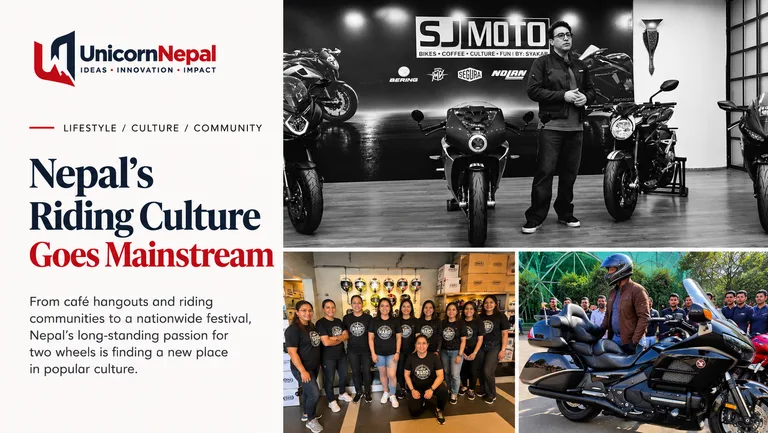
In 2021, Jyoti decided to share that world by opening SJ Moto, a motorcycle gallery and café in Kathmandu.
The result was something considerably more personal than a conventional showroom.
Vintage Hondas, classic machines, modern superbikes and rare motorcycle memorabilia occupied spaces alongside superhero collectibles, helmets, model vehicles and comic-book-inspired decorations.
The café's menu embraced the same playful spirit. A cappuccino became a Superccino. An Americano became a Captain Americano. There was Bat Latte, Wonder Chocolate and traditional Newari lakhamari alongside coffee.
The original space, designed by Arati Jyoti, brought together Saurabh's passion for motorcycles and his fondness for superheroes.
It was an unusual combination, but one that reflected the man behind the collection.
In a 2021 interview with Nepali Times, Jyoti described SJ Moto as a free gallery where he could share his enjoyment of motorcycles and encourage visitors to preserve their sense of childhood wonder.
That idea has continued to evolve.
In April 2025, SJ Moto partnered with Himalayan Java to open a motorcycle-themed café on Lakeside Road in Pokhara, a natural gathering point for travellers heading towards some of Nepal's most celebrated riding routes.
In February 2026, the Kathmandu collaboration reopened with redesigned interiors and a larger seating area.
The idea remained straightforward: give riders, coffee lovers and curious visitors somewhere to meet, spend time and share their stories.
In a country where coffee culture has increasingly become part of urban social life, SJ Moto brings an unmistakably Nepalese character to that experience.
There are motorcycles with family histories, vintage machines restored with patience, local culinary touches and the possibility of meeting someone whose next journey might inspire your own.
For a man associated with an industrial conglomerate, it is a surprisingly intimate legacy.
The family business brought motorcycles into Nepal. SJ Moto gives people somewhere to celebrate what those motorcycles mean to them.
The Sisterhood, the Brotherhood and the Freedom of the Open Road
Nepal's motorcycle culture has never belonged to one company, one club or one generation.
Long before Nepal Bike Day, riders were forming friendships across cities and organising trips to places that seemed almost impossible to reach on two wheels.
The Federation of Royal Enfield Clubs Nepal, for instance, traces its annual Nepal Riders' Meet to 2017, when 170 riders gathered in Bardiya.
Subsequent editions travelled to different parts of the country, turning the gathering into a tradition built around riding, camping, local tourism and friendship.
That sense of belonging is central to motorcycle culture.
You don't necessarily need to own the newest machine or the largest engine. The experience often begins with a shared destination, a roadside stop or another rider offering help when something goes wrong.
Increasingly, Nepalese women are making their own mark on that culture.
Tulsa Pahadi, founder and president of Dui Pangre Queens, is among the women helping create more space for female motorcyclists.
The organisation brings women together through riding, cultural exploration, tourism promotion and road-safety advocacy.
Its community also includes Pabina Khadka, known as Mountain Girl, whose enthusiasm for adventure and motorcycle journeys has made her a recognisable figure among women riders.
Susmita Adhikari, a motovlogger associated with Dui Pangre Queens, represents another side of the movement: telling riding stories through digital platforms and bringing those experiences to people who may never have considered getting on a motorcycle themselves.
Then there's Kreetika Thapa, a motorcycle tour road captain and guide whose work connects adventure riding with travellers exploring Nepal's Himalayan landscapes.
Her involvement in the international Women Riders World Relay community also reflects how Nepalese riders are becoming part of conversations and networks extending beyond national borders.
Their stories are different, but they share an important idea.
For these women, riding isn't simply a convenient way to travel. It can be an expression of independence, confidence, curiosity and identity.
The growth of organised women-led riding experiences makes that increasingly visible.
Between October 29 and November 1, 2026, 40 women riders joined Royal Enfield's Mystic Mustang Ride 2, travelling from Pokhara into the mountain landscapes of Mustang.
The four-day journey was organised to encourage adventure riding, strengthen confidence and create connections among participants.
There is something particularly meaningful about that image: forty women exploring the Himalayas together, not because they need transportation, but because they choose the experience.
And that is where motorcycle culture becomes something more than a hobby.
It's a way of discovering places, building confidence, recording memories and finding people who understand a passion that may be difficult to explain to those who don't ride.
For some, that means an early-morning escape from Kathmandu. For others, it's a journey across Mustang, a weekend gathering of Royal Enfield enthusiasts or a first experience riding alongside a group.
Whatever the destination, the common ground is the same.
The motorcycle brings people together. The experiences make them a community.
Nepal Bike Day: When a Riding Community Gets Its Own Festival
For years, Nepal's riders have organised club gatherings, long-distance journeys, restoration projects and motorcycle events.
What Nepal Bike Day adds is a more public celebration of that world.
The inaugural festival took place on June 1, 2024, at Heritage Garden in Lalitpur, organised by Collab Entertainment and fellow motorcycle enthusiasts.
It wasn't simply an exhibition of machines.
The event combined superbike displays, motorcycle showcases, a short group ride, food, music and entertainment, creating a setting where motorcycle enthusiasts and the wider public could share the same experience.
Performances included Nepalese artists Yabesh and Bizen, international performer Karl Wine and several DJs.
The programme also recognised motorcycles across different categories, celebrating everything from Italian and Japanese machines to American, German and high-performance models.
In another significant moment, the event highlighted Nepalese racers Abhinav Raj Malla and Shree Hari Poudel, who were preparing to participate in the Indian National Motorcycle Racing Championship.
That combination of music, machines, personal passion and emerging sporting talent gave the celebration a character beyond a conventional automotive exhibition.
It made space for the wider lifestyle surrounding motorcycles.
The festival has continued developing its presence.
Ahead of the November 7, 2026 edition at Heritage Garden, organisers collaborated with Xtreme on a promotional showcase at the NADA Auto Show.
Seven privately owned superbikes were displayed, offering visitors a glimpse into the enthusiast culture behind the annual event.
Anjay Shakya, associated with Collab Entertainment's operations, was among the organisers speaking publicly about the festival's preparations.
The event's significance lies in bringing a previously dispersed culture into a more visible public setting.
Riding clubs already existed. Collectors already had their garages. Women were already exploring mountain roads. Enthusiasts had already built their own friendships and traditions.
Nepal Bike Day creates an occasion for those different worlds to meet.
That is also why people such as Saurabh Jyoti have an important place in the larger story.
His SJ Moto cafés offer a year-round expression of the same enthusiasm, while gatherings such as Nepal Bike Day create public occasions to celebrate it.
Neither created Nepal's riding culture. Both reflect how deeply it has become part of people's lives.
And there is room for the celebration to become more inclusive still.
The appeal of motorcycle culture shouldn't be limited to expensive superbikes or people who can afford long-distance adventures. A young rider on a modest commuter motorcycle can have just as meaningful a relationship with the road.
The women building their own riding communities, the mechanics restoring vintage engines, the photographers documenting journeys and the friends organising weekend rides all belong to the same story.
Responsible riding must belong there too. Helmets, protective equipment, road awareness and respect for other road users are essential if the celebration is to grow sustainably.
Nepal Bike Day's potential lies in bringing these different identities together without losing what made the community special in the first place.
The sense that riders look out for one another.
The shared excitement over an unfamiliar machine.
The friendships that survive long after a journey ends.
And the freedom of discovering a beautiful road with people who understand why you wanted to take it.
For Saurabh Jyoti, motorcycles are a connection to childhood, family and some of his most cherished memories.
For the women exploring Nepal's mountain roads, they can represent confidence and independence.
For the organisers behind Nepal Bike Day, they provide a reason to bring an entire community together.
Different people. Different motorcycles. Different journeys.
But a remarkably similar feeling.
Nepal has been riding for generations. Nepal Bike Day is giving more people a reason to celebrate the life that comes with it.