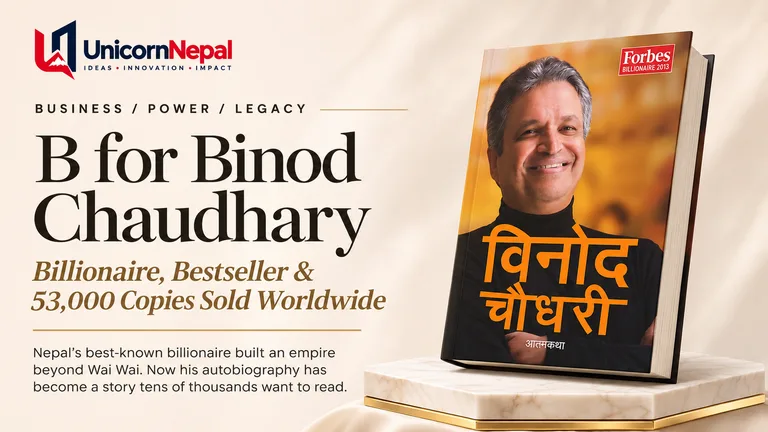
B for Binod Chaudhary: Billionaire, Bestseller & 53,000 Copies Sold Worldwide
From a family trading business in Kathmandu to a multinational empire, Nepal's only Forbes-listed billionaire has spent decades building businesses, navigating politics and shaping his public legacy. Now, with a reported 53,000 copies of his autobiography sold, the story behind his fortune has become a business of its own.
Column ·B for Binod Chaudhary: Billionaire, Bestseller & 53,000 Copies Sold Worldwide
B for Binod Chaudhary: Billionaire, Bestseller & 53,000 Copies Sold Worldwide
From a family trading business in Kathmandu to a multinational empire, Nepal's only Forbes-listed billionaire has spent decades building businesses, navigating politics and shaping his public legacy. Now, with a reported 53,000 copies of his autobiography sold, the story behind his fortune has become a business of its own.
There is hardly a Nepalese household unfamiliar with Binod Chaudhary, even if its members have never met him.
They know Wai Wai, the instant noodles that became a national favourite. They recognise the CG name on products, financial institutions and telecommunications services. Some have encountered his businesses in hotels far beyond Nepal's borders.
And then there is Forbes.
In 2013, Chaudhary became Nepal's first billionaire on the magazine's global list, putting a businessman from Kathmandu alongside some of the world's wealthiest individuals.
But while his fortune made headlines, another part of his story was quietly finding an audience.
That same year, Chaudhary published his autobiography, Atmakatha, offering readers a glimpse into the ambitions, relationships, rivalries and decisions that shaped his life.
More than a decade later, promotional material reports 53,000 copies sold worldwide—a figure that was self-proclaimed by Binod Chaudhary himself on Linkedin.
For a man whose wealth is measured in billions of dollars, selling books is hardly a financial breakthrough.
But perhaps the more interesting question is why so many people want to know how he got there.
Born Into Business. Restless Beyond It.
Binod Chaudhary inherited more than a surname.
His grandfather, Bhuramal Das Chaudhary, laid the family's commercial foundations after migrating from Rajasthan to Nepal. His father, Lunkaran Das Chaudhary, expanded those beginnings into a diversified enterprise that included construction, trading and Kathmandu's Arun Emporium.
Business was already part of the family's everyday language by the time Binod entered it.
He had access to an established enterprise, supplier relationships and commercial opportunities that many aspiring Nepalese entrepreneurs could only imagine.
Yet his early interests hardly suggested a conventional industrialist.
As his autobiography recounts, the young Chaudhary was drawn to music, cinema and Kathmandu's lively entertainment scene. He pursued singing and filmmaking and became involved in Copper Floor, a discotheque associated with the city's 1970s social and tourism culture.
These episodes reveal an often overlooked side of the businessman: before he became known for factories and investments, he was fascinated by audiences, experiences and popular culture.
That instinct eventually found a far larger stage.
Wai Wai, introduced through the Chaudhary Group, grew into one of Nepal's most recognisable consumer brands.
For generations, the noodles became part of school lunches, roadside journeys and ordinary household routines.
Few Nepalese products have achieved the same cultural familiarity.
But Chaudhary's wealth was never built on noodles alone.
Under his leadership, the family's business interests expanded across banking, food manufacturing, hospitality, consumer goods, infrastructure and telecommunications.
CG Corp Global reports interests in more than 200 companies and 260 brands, employing over 20,000 people across an international business network.
The conglomerate's reach extends from CG Foods and Nabil Bank to international hotels and hospitality partnerships, including properties associated with the Taj and The Fern brands.
Through CG Net, the group also entered Nepal's competitive internet-service market.
The transformation is substantial: from a family trading operation to a diversified enterprise with investments extending well beyond the Himalayas.
Yet its origins matter.
Chaudhary was not a self-made billionaire in the familiar rags-to-riches sense. He inherited an established foundation and expanded it on a remarkable scale.
Today, his sons Nirvana, Rahul and Varun participate in managing different parts of the business, carrying the family enterprise into another generation.
It is a story of inheritance, expansion and succession.
And, perhaps most importantly, of understanding that a family's greatest asset can be its ability to keep reinventing what it does.
The Fortune, the Palace and the Politics
The extraordinary thing about Binod Chaudhary's career is not simply the money.
It is how frequently his life intersects with Nepal's most influential institutions.
His autobiography moves through royal residences, political relationships, commercial negotiations and the often complicated social networks surrounding business in Nepal.
One episode involving Princess Prekshya and shares in Apollo Steel offers a glimpse into the relationships and disputes that shaped commerce during the monarchy.
Such accounts are revealing because they challenge the idea that business success occurs in isolation.
Chaudhary built his enterprise through decades in which Nepal experienced profound political changes—from monarchy and the democratic movement to civil conflict, republicanism and a new constitutional order.
His companies continued operating and expanding through those transitions.
And eventually, he stepped directly into politics himself.
He entered the Constituent Assembly through the CPN-UML in 2008, later moved to Nepali Congress and won a directly contested parliamentary seat from Nawalparasi West in 2022.
Following his electoral defeat in March 2026, he became a Nepali Congress vice-president in October of the same year.
For someone already associated with one of Nepal's largest business groups, political office added another dimension to his public influence.
It also invited more difficult questions.
Can a billionaire industrialist separate private commercial interests from public responsibilities? Does business experience make someone better equipped to influence economic policy? And how should voters evaluate the political influence that comes with enormous wealth?
There are no simple answers.
Beyond business and politics, Chaudhary has also cultivated a philanthropic legacy.
Through the Chaudhary Foundation, established in 1995, his group has supported initiatives spanning education, healthcare, livelihoods and disaster recovery.
Following the devastating 2015 earthquakes, the foundation reported building more than 3,000 transitional shelters and 40 school facilities in affected communities.
These efforts form part of his public record, alongside the economic contributions and controversies that accompany a business empire of such scale.
Taken together, they reveal a man whose life has become intertwined with the country's commercial, social and political evolution.
He did not simply build businesses in Nepal. He built his career through several different versions of Nepal.
The Billionaire Everyone Knows. The Man 53,000 Readers Wanted to Meet.
In 2013, as Forbes recognised Chaudhary's billionaire status, Nepalaya released his autobiography, developed over approximately four years with journalist Sudeep Shrestha.
The timing was remarkable.
At precisely the moment international audiences were discovering Nepal's first dollar billionaire, local readers were being offered the story behind the fortune.
Atmakatha went beyond company histories and financial milestones.
It revisited childhood ambitions, family expectations, entertainment ventures, difficult decisions, business disputes and encounters with influential personalities.
The book presented Chaudhary not merely as the chairman of a conglomerate, but as someone shaped by creative ambitions, relationships, opportunities and mistakes.
Its original Nepali edition was followed by English-language publications, including Making It Big, extending his story to readers across South Asia and beyond.
His more recent book, Made in Nepal, continues that publishing journey, placing greater emphasis on lessons from building an international business.
The reported 53,000-copy milestone suggests that curiosity about Chaudhary extends beyond his net worth.
But it also raises an interesting contradiction.
An autobiography is both a personal record and a carefully chosen account. It tells readers how its author remembers his journey, which victories he celebrates, which failures he acknowledges and which relationships he considers important.
It does not replace independent examination of the wealth, advantages, political connections or commercial decisions behind the story.
And that is precisely what makes the book worth discussing.
For an aspiring entrepreneur, it may offer lessons about risk and perseverance. For a student, it offers a window into a Nepalese business career spanning generations. For a critic, it opens questions about privilege, influence and the relationship between private wealth and public power.
Readers do not have to agree on what Binod Chaudhary represents to find his life worth examining.
His legacy reaches across industries, generations and borders. His products have become household names, his investments have linked Nepal to international markets, and his political journey remains part of the country's public debate.
Yet behind all of it is a businessman who once wanted to make music and films, inherited a family enterprise, and eventually found himself among the wealthiest people in the world.
Perhaps the book's greatest appeal lies in that distance between the beginning and the outcome.
Everyone knows Binod Chaudhary became a billionaire. Far fewer know the decisions, relationships and contradictions that brought him there.
He spent decades building an empire that introduced his name to millions.
Now, tens of thousands have reportedly paid to discover the person behind it.
The billions made Binod Chaudhary a household name. The autobiography asks a more interesting question: after knowing what he built, do we really know the man?