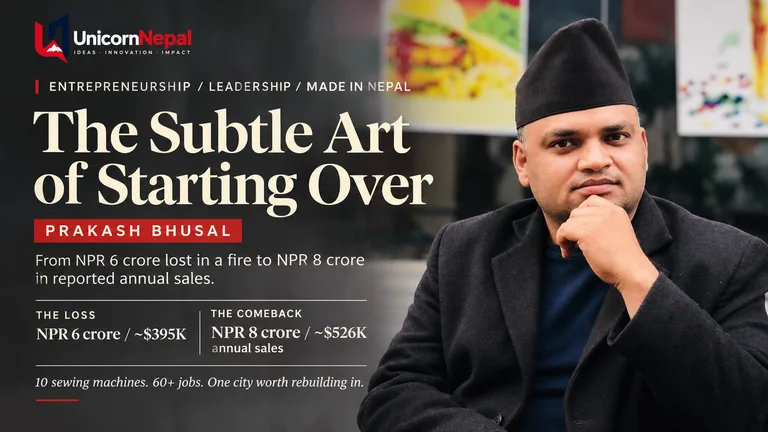
Prakash Bhusal and the Subtle Art of Starting Over
He lost NPR 6 crore ($395,000) in a fire, borrowed ten sewing machines and began again with five workers. Two years later, his business reports NPR 8 crore ($526,000) in annual sales. But in a country where thousands seek work abroad every day, the extraordinary part of Prakash Bhusal's story may be that he chose to rebuild in Butwal.
He lost NPR 6 crore ($395,000) in a fire, borrowed ten sewing machines and began again with five workers. Two years later, his business reports NPR 8 crore ($526,000) in annual sales. But in a country where thousands seek work abroad every day, the extraordinary part of Prakash Bhusal's story may be that he chose to rebuild in Butwal.
There are many reasons to leave Nepal. Prakash Bhusal had one more than most.
On June 20, 2024, a fire tore through Delta Mart in Butwal, destroying a commercial complex developed with 34 investors and approximately NPR 30 crore ($1.97 million) in capital. Preliminary estimates put the damage across the premises at NPR 40 crore ($2.63 million). Among the losses was Bhusal's clothing business, representing approximately NPR 6 crore ($395,000) in investment.
Years of work disappeared in hours.
For a businessman with financial obligations, employees and a family, the fire offered no obvious path forward. Some expected him to return to his ancestral village in Arghakhanchi. Others thought he might leave the country.
In Nepal, neither possibility would have seemed unusual.
The country has spent the past decade rebuilding from earthquakes, floods and repeated economic disruptions. Its young people continue to seek opportunities overseas at extraordinary rates. In fiscal year 2025/26 alone, the government issued approximately 792,000 foreign-employment labour approvals, including renewals—an average of more than 2,100 a day.
That figure doesn't mean every approval represented a different person departing that day. But it illustrates the scale of Nepal's dependence on overseas employment.
Bhusal chose another direction.
Within two weeks of the fire, he obtained ten sewing machines on credit and gathered five workers.
He started making clothes again.
Today, his Lord Buddha Garment Industry reports more than NPR 8 crore ($526,000) in annual turnover, employs approximately 60–65 people and operates three outlets in Butwal.
It is a small business by global standards. But its significance lies in the distance between what Bhusal lost, what he had left and what he was willing to attempt again.
The Geography of Ambition
Before the fire, before the investors, before the crores, there was a schoolboy in Arghakhanchi imagining a better way for families to buy everyday necessities.
Bhusal wanted to create a place where students could find uniforms, books, shoes and educational services together.
The idea followed him to Butwal, where he began experimenting with businesses rather than waiting for the perfect opportunity.
In 2008, he joined six friends to establish an educational venture with reported individual contributions of NPR 25,000 ($165).
Later, using NPR 3 lakh in savings and another NPR 3 lakh borrowed from relatives, he started White House Uniform.
The business evolved around a familiar problem: parents moving between shops to find everything their children needed for school.
Bhusal saw an opportunity to bring the products together.
Not every idea succeeded.
An attempt to manufacture aluminium food containers became entangled in a lengthy dispute over machinery ordered from India. He later participated in the development of a 25 MW hydropower project, expanding his experience into an entirely different industry.
His ventures had little in common beyond one instinct: he kept identifying things he believed could be done differently.
By 2019, that ambition had taken a more substantial form.
Bhusal brought together 34 investors for Delta Educational Mart, a commercial venture representing approximately NPR 30 crore ($1.97 million) in reported investment.
He had moved from contributing a few thousand rupees to helping assemble a business backed by crores.
And he did it in Butwal.
That distinction matters.
Across South Asia, stories of entrepreneurial ambition tend to gravitate towards metropolitan centres: Mumbai, Bengaluru, Dhaka, Karachi or Kathmandu. These cities concentrate investors, corporate headquarters, established networks and media attention.
But economies are also built elsewhere.
Butwal, located within Nepal's Lumbini economic corridor, has long served as a commercial link between the country's western districts, industrial communities and cross-border trade with India.
It lacks Kathmandu's concentration of national institutions and investment networks, but offers its own market, workforce and entrepreneurial possibilities.
Bhusal's achievement was not simply imagining a NPR 30 crore project. It was convincing 34 people to participate in that vision outside the capital.
Those investors were accepting financial risk alongside him.
When Delta Mart burned, the loss was therefore shared across a network of people who had believed the business could succeed.
And the man who had persuaded them to build something substantial was suddenly faced with the possibility of beginning again from almost nothing.
What the Fire Could Not Take
Nepal knows something about starting over.
The earthquakes of 2015 killed nearly 9,000 people and caused approximately $7 billion in physical damage. The November 2023 earthquake in western Nepal killed 154 people and damaged tens of thousands of homes.
In September 2024, severe floods and landslides caused an estimated NPR 46.7 billion ($307 million) in damage across the country.
These disasters were different in nature and scale from Bhusal's commercial loss. They are not interchangeable tragedies.
But together, they form part of the national environment in which Nepalese businesses operate: one where physical infrastructure, livelihoods and accumulated capital can be unusually vulnerable to sudden disruption.
Bhusal's own disaster came in June 2024.
The Delta Mart fire destroyed businesses across the complex, including his investment in Nepali Luga Ghar.
The financial consequences extended beyond the physical loss. Creditors still expected repayment. Employees had lost their workplace. Business relationships built over years faced an uncertain future.
Bhusal later described sleepless nights and days spent driving between Butwal, Bhairahawa and neighbouring towns, trying to determine what to do next.
Then he returned to something he already knew.
Clothing.
He obtained ten sewing machines on credit, found five workers and began producing garments.
The contrast was extraordinary.
A man who had helped coordinate a NPR 30 crore commercial development was starting again with equipment he did not yet own outright.
But the machines were only part of the story.
Suppliers still had to extend credit. Workers had to believe the factory could provide employment. Customers had to place orders with a business trying to recover from a devastating loss.
What survived the fire was not simply Bhusal's willingness to work.
It was enough of his experience, relationships and reputation for other people to take another chance alongside him.
His buildings had burned. His ability to convince people to build with him had not.
The new enterprise also represented a change in approach.
Rather than depending primarily on retail inventory, Lord Buddha Garment Industry began producing against customer orders, serving schools, institutions and clothing buyers.
It was a practical form of risk management: produce what customers need, control inventory and build around demand.
The approach resembles the economics of countless small garment manufacturers across South Asia.
Such businesses cannot compete with global fashion groups on capital or scale. Their survival depends on relationships, reliable production, working capital and understanding the needs of customers close to home.
For Bhusal, the challenge was more personal.
He wasn't starting his first business.
He was starting another one while carrying the consequences of the last.
The Courage to Stay
Two years after the fire, Bhusal's garment operation reports more than NPR 8 crore ($526,000) in annual sales.
Its workforce has grown from five to approximately 60–65 people, with three outlets and customers extending beyond Butwal to cities including Surkhet and Dhangadhi.
Those are company-reported figures, not audited profits. The extent of Bhusal's personal financial recovery and any remaining liabilities has not been publicly established.
Nevertheless, the operation represents something tangible: production, employment and a functioning regional business where there had recently been little more than uncertainty.
And this is where his story intersects with Nepal's larger economic challenge.
In FY2025/26, the country received approximately NPR 2.36 trillion ($16.19 billion) in remittances.
Money earned abroad supports household spending, education and investment across Nepal. Overseas work is not a failure of ambition; for many families, it is a practical and often necessary choice.
But it also reveals the difficulty of creating enough attractive livelihoods at home.
Bhusal's factory cannot solve that problem.
Sixty-five jobs are a tiny contribution relative to the country's employment needs.
Yet they are sixty-five positions in a business that began with five people and borrowed equipment.
For a country seeking stronger domestic production, that kind of expansion matters.
Building something Made in Nepal requires far more than a label. Manufacturers need skilled labour, affordable inputs, dependable logistics, competitive prices and customers willing to purchase locally produced goods.
Nepalese garment businesses operate alongside powerful Indian and Chinese supply chains and an international apparel industry measured in hundreds of billions of dollars.
Bhusal's reported half-million-dollar turnover is modest in that context.
But perhaps that is precisely why the story deserves telling.
Most businesses that create livelihoods are not billion-dollar companies. They are workshops, factories, service providers and family enterprises built around local demand.
Their contribution is measured not only by revenue, but by the work they create and the economic activity they sustain.
Bhusal's ambitions also extend beyond garments.
In 2026, he returned to the former Delta Mart premises with Deepak Dhakal, Sudip Kafle and Siddhartha Thapa.
Together, they established NextGen Adventure Entertainment, a venture featuring an immersive cinema and mirror maze, with reported collective investment of approximately NPR 2.5 crore ($164,000).
It was a different business, backed by different partners, at the same location where his previous venture had been destroyed.
The new enterprise's profitability remains unproven. Nor does its opening mean the financial damage of 2024 has been fully repaired.
But returning to that building says something about Bhusal's relationship with risk—and with Butwal itself.
He could have left the city associated with his greatest loss. Instead, he is manufacturing clothes, employing people and pursuing another venture there.
There is no guarantee that every new idea will succeed.
Bhusal's entrepreneurial history already contains ventures that failed to materialise, investments that were lost and plans that took unexpected turns.
That makes his comeback more meaningful, not less.
He is not an entrepreneur whose instincts have always been rewarded.
He is one who has continued putting those instincts to work after experiencing their consequences.
For Nepal, his story belongs alongside a larger question: how can the country's secondary cities become places where ambitious people can build sustainable careers and businesses without feeling compelled to move to Kathmandu—or abroad?
The answer will require far more than individual resilience. It will require financing, infrastructure, reliable institutions, skilled workers and markets capable of supporting productive businesses.
Yet the people who choose to build under existing conditions are part of that answer too.
Prakash Bhusal began with NPR 25,000, helped bring together a NPR 30 crore venture, lost a reported NPR 6 crore business investment and started again with ten machines.
Today, his factory reports more than NPR 8 crore in annual sales.
Those figures do not describe an uninterrupted success story. They describe a life in which ambition has repeatedly outlived the businesses carrying it.
Some people leave home to find their next opportunity. Prakash Bhusal chose to create another one in the place where his last had disappeared.
And perhaps the art of starting over is not about recovering everything you lost.
Perhaps it is about discovering that you can still build something worth staying for.