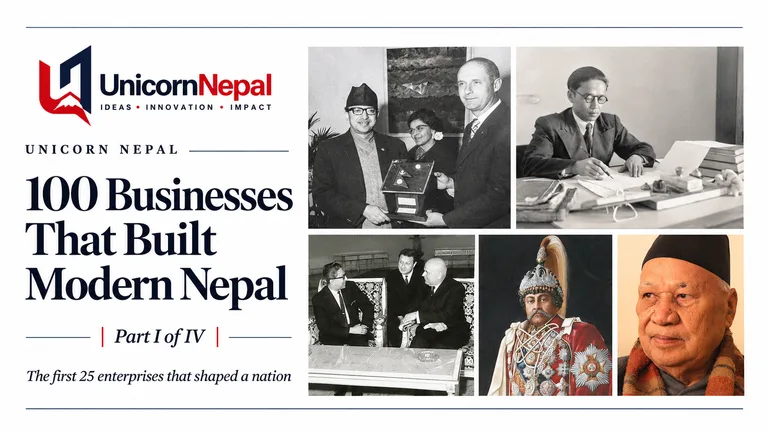
100 Businesses That Built Modern Nepal: Part I of IV
From Biratnagar's jute mills to Gorkha's abandoned tyre factory, the first 25 enterprises reveal how Nepal built its industrial ambitions, financed its economy, employed generations—and lost some of the capabilities it once possessed.
100 Businesses That Built Modern Nepal: Part I of IV
100 Businesses That Built Modern Nepal, Part I: Where It All Began
From Biratnagar's jute mills to Gorkha's abandoned tyre factory, the first 25 enterprises reveal how Nepal built its industrial ambitions, financed its economy, employed generations—and lost some of the capabilities it once possessed.
UNICORN NEPAL | SPECIAL EDITORIAL SERIES | PART I OF IV
In Gorkha, a factory that once manufactured thousands of automobile tyres sits behind ageing walls. Machinery gathers rust. Residential quarters built for employees stand largely deserted. The buildings remain, but the production lines that gave them purpose have stopped.
In Hetauda, another factory offers a different scene. In August 2026, after more than two decades of silence, workers and technicians managed to restart a handful of textile looms. Twelve machines began turning in a complex containing 488.
Across Nepal, these factories are reminders of an economic history that is rarely told in full.
Long before ride-hailing apps, digital wallets, hydropower exports and startup valuations, Nepal was attempting something considerably more fundamental: manufacturing the goods its people consumed, building institutions to finance commerce, connecting isolated communities and creating industrial employment.
Much of that ambition emerged in the decades surrounding the end of Rana rule and the reigns of Kings Mahendra and Birendra.
The Biratnagar industrial corridor introduced factory employment on an unprecedented scale. Commercial banks began mobilising savings. State enterprises manufactured cement, textiles, paper and footwear. International partnerships brought machinery, engineers and financing from India, China, the Soviet Union and other countries.
These were not simply businesses. They were investments in the country's ability to produce, trade, employ and develop.
Some survived. Many did not.
Today, Nepal can export electricity, move billions of rupees through digital financial networks and connect millions of people through telecommunications. Yet its industrial history also includes factories that could not purchase raw materials, pay employees or compete with imported products.
That contradiction is central to this series.
What did these enterprises contribute to Nepal's economy? Who built and sustained them? How many livelihoods depended on them? And what remains of their achievements today?
The following 25 businesses are not ranked by wealth, age or popularity. They have been selected for the part they played in building economic capabilities that Nepal previously lacked.
Their histories are stories of investment, industrial ambition, personal leadership, political decisions, economic opportunity and, sometimes, extraordinary institutional failure.
I. The First Industrial Economy
Biratnagar Jute Mills: Where Industry and Political History Met
A factory built to process jute would eventually help produce some of Nepal's most consequential political movements.
Biratnagar Jute Mills opened in 1936 with Nepali and Indian investment, creating industrial demand for agricultural raw materials and organised factory labour in eastern Nepal.
At its height, according to a 2025 historical account, the mill employed approximately 2,400 workers alongside 400 other staff. That represented an extraordinary concentration of formal employment in a country where most families depended on agriculture.
The economic effects extended into transportation, agricultural procurement, trading and the development of Biratnagar as an industrial centre.
But the factory also became a political landmark.
In March 1947, its workers launched a labour movement associated with leaders including Girija Prasad Koirala and Manmohan Adhikari. Demands for improved working conditions became intertwined with resistance to Rana rule.
The enterprise later suffered from financial distress, ownership and management disputes, and repeated unsuccessful revival efforts.
Today, its neglected industrial infrastructure stands in sharp contrast to the influence it once exercised.
What remains is more than a factory's history: Biratnagar Jute Mills helped create an industrial workforce that changed both Nepal's economy and its politics.
Raghupati Jute Mills: Nepal's Early Manufacturing Export Bet
Raghupati Jute Mills emerged at a time when Nepal was beginning to discover the commercial possibilities of industrial manufacturing.
Established in 1946, it expanded the processing of jute into products such as sacks and hessian fabric, serving domestic and regional markets.
Its location near the Indian border provided access to raw materials, trading routes and commercial distribution networks. That geography helped eastern Nepal become the country's most important early industrial region.
The mill also represented a transition from exporting agricultural commodities toward manufacturing products with additional commercial value.
A historical UNIDO rehabilitation assessment envisaged approximately 7,500 tonnes of annual output following modernisation. That figure was a proposed production target, rather than a verified record of actual output.
The enterprise's wider impact included employment for factory workers, demand for agricultural suppliers and opportunities for transporters and traders.
Raghupati's significance lies in the industrial model it helped sustain: buying agricultural inputs, processing them with machinery and selling finished products into larger markets.
It was an early example of the value Nepal could create by manufacturing rather than simply trading raw materials.
II. The Money Behind Modern Nepal
Nepal Bank: From Rs 842,000 to a National Financial Institution
Established: November 15, 1937 | Promoter: Government and private investors | Industry: Commercial banking | Present context: Operating
In 1937, Nepal's first commercial bank began with paid-up capital of approximately Rs 842,000 and only 12 employees.
Its early balance sheet recorded Rs 1.7 million in deposits and Rs 1.98 million in loans.
Among its first documented lending transactions were Rs 1,500 to Bhajuratna for a ghee business and Rs 3,000 for a footwear enterprise.
Small amounts by modern standards, but important milestones for a country whose commerce largely depended on informal financing.
Nepal Bank introduced a formal institution through which savings could be mobilised and businesses could obtain credit. As the economy developed, its services expanded into financing enterprises, trade and households.
By July 2025, Nepal Bank operated 292 branches. Nepal Rastra Bank reported approximately Rs 336.9 billion in deposits and Rs 236.2 billion in loans.
Those figures capture the transformation from a small pioneering institution into an organisation managing hundreds of billions of rupees.
The bank has also experienced periods of financial distress and restructuring, reminders that longevity does not guarantee sound management.
Nepal Bank's defining achievement was helping establish the financial machinery through which private savings could become productive capital.
Nepal Arab Bank: The Foreign Partnership That Changed Banking
Established: July 12, 1984 | Original partner: Dubai Bank Limited | Industry: Commercial banking | Today: Nabil Bank
When Nepal Arab Bank Limited entered the market in 1984, Nepal's commercial banking sector had operated for decades with comparatively limited competition.
Its establishment as the country's first foreign joint-venture commercial bank introduced an important shift in banking ownership, customer expectations and commercial practice.
Dubai Bank Limited was the original foreign partner. International expertise, more competitive financial services and new approaches to commercial banking became part of Nepal's changing financial landscape.
The bank adopted the name Nabil Bank in 2002.
Its subsequent growth also reflected acquisitions and consolidation, particularly the merger with Nepal Bangladesh Bank in 2022.
By July 2025, Nepal Rastra Bank recorded 289 Nabil branches. Its 2024/25 financial statement reported loans and advances of approximately Rs 434 billion, while deposits exceeded Rs 500 billion.
The historical significance is not that Nepal Arab Bank invented banking. Nepal Bank had already done that.
Its contribution was helping move the industry toward international participation, competition and private commercial expansion.
A partnership that began with a foreign bank in 1984 ultimately became one of the country's major domestic financial institutions.
Rastriya Banijya Bank: Rs 503 Billion in Deposits, Built on a 1966 Mandate
Established: January 23, 1966 | Founder: Government of Nepal | Industry: Commercial banking | Present context: Operating
Rastriya Banijya Bank was established when expanding formal financial services was central to Nepal's development agenda.
The government-owned institution helped extend commercial banking to areas where private financial services remained limited.
Its expansion supported public institutions, merchants, enterprises and households, becoming part of the financial infrastructure serving communities across Nepal.
By July 2025, it operated 370 branches.
Nepal Rastra Bank reported approximately Rs 502.8 billion in deposits and Rs 308.9 billion in loans at that time.
That scale, however, was achieved through a difficult institutional history.
The bank experienced serious financial weaknesses and governance problems around the turn of the century, leading to restructuring supported by broader financial-sector reform.
Its survival reflects both the advantages and risks of state ownership.
Rastriya Banijya Bank was not simply an instrument for extending credit. It was also a test of whether a national financial institution could combine public responsibility with commercial discipline.
Its story is about the expansion of banking across Nepal—and the difficult work required to keep such an institution financially viable.
Agricultural Development Bank: Financing the Country That Farms
Established: January 1968 | Original mandate: Agricultural development | Industry: Banking and rural finance | Present context: Operating
Nepal's farmers have historically faced a financing problem that conventional commerce does not always encounter.
Seeds, livestock, irrigation and equipment require investment before income arrives. Agricultural production is seasonal, vulnerable to weather and often difficult to finance through ordinary short-term lending.
Agricultural Development Bank Nepal was established in 1968 to help address that gap.
Succeeding the Cooperative Bank and later absorbing the Land Reform Savings Corporation, it helped connect farming and rural enterprise with formal finance.
The institution subsequently evolved into a full commercial bank.
Its 2023/24 annual report recorded 271 branches, 2,372 employees, approximately 2.1 million deposit accounts and 165,015 loan accounts.
By July 2025, Nepal Rastra Bank reported approximately Rs 293.7 billion in deposits and Rs 216 billion in loans.
These figures include its broader commercial banking activities, not exclusively agricultural lending.
The bank's significance is the financial infrastructure it created around an economy heavily dependent on rural production.
Agricultural Development Bank helped bring farmers into a formal credit system that had previously been far better suited to merchants and urban enterprises.
NIDC: The Institution Created to Finance Nepal's Factories
Established: 1959 | Founder: Government of Nepal | Industry: Development finance | Present context: Merged into Rastriya Banijya Bank in 2018
Factories require capital long before they begin generating revenue.
Nepal Industrial Development Corporation was established in 1959 because ordinary commercial financing was poorly suited to the long investment cycles of industrial development.
NIDC provided loans and equity investment while supporting industrial estates, feasibility studies and other initiatives intended to encourage manufacturing.
An IMF assessment from 1963 recorded Rs 10 million in authorised capital. By July 1962, the corporation had disbursed approximately Rs 3.4 million in loans, invested Rs 1.5 million in company shares and committed another Rs 1.3 million to industrial estates.
Those early sums illustrate an economy attempting to build an industrial financing system almost from the ground up.
A later World Bank assessment noted that NIDC remained Nepal's only source of medium- and long-term private industrial financing until commercial banks were permitted to undertake such lending in 1975.
The institution eventually struggled with financial weaknesses and deteriorating loan performance.
It was absorbed into Rastriya Banijya Bank in 2018.
NIDC helped finance Nepal's industrial ambitions. Its eventual disappearance also revealed how difficult it was to build a sustainable development-finance institution.
Nepal Insurance: The Company That Made Commercial Risk Insurable
Established: 1947 | Original name: Nepal Malchalani Tatha Beema Company | Industry: General insurance | Present context: Operating
Nepal's early businesses could borrow money, transport goods and operate factories, but protecting their assets against financial losses was another challenge.
In 1947, Nepal Malchalani Tatha Beema Company was established with the backing of Nepal Bank Limited.
It became the country's first domestic insurance enterprise.
The company later operated as Nepal Insurance and Transport Company before adopting its present name in 1991.
The economic significance of insurance is easily overlooked. Businesses are more willing to invest when assets, shipments and equipment can be protected against specified risks. Insurance can also support access to credit and commercial contracts.
Today, Nepal Insurance reports a network of 55 branches and more than 300 personnel.
The broader industry it helped pioneer has grown substantially: Nepal Insurance Authority statistics show non-life insurers collected approximately Rs 48.15 billion in premiums in FY 2025/26.
That is an industry-wide figure, not Nepal Insurance's own revenue.
The enterprise's legacy is an entire category of financial services that helps businesses manage the risks of owning, producing and trading.
III. The Enterprises That Connected Nepal
Royal Nepal Airlines: The 28-Seat Aircraft That Changed Geography
Established: July 1, 1958 | Founder: Government of Nepal | Industry: Aviation | Present context: Operating, with longstanding financial and fleet challenges
Nepal's national airline began with a Douglas DC-3 Dakota carrying 28 passengers.
For many communities, aviation arrived before roads.
Established in July 1958, Royal Nepal Airlines Corporation gradually connected towns including Biratnagar, Pokhara, Bhairahawa and Simara, before expanding services into more difficult mountain regions.
In 1961, the airline introduced the six-seat Pilatus Porter, an aircraft well suited to short take-off and landing operations in rugged terrain.
The economic effect extended beyond passenger convenience.
Air transport enabled tourism, business travel, movement of supplies and connections between communities that were otherwise separated by difficult journeys.
The airline later expanded internationally, becoming part of Nepal's commercial relationship with regional and overseas markets.
Its subsequent history has been troubled by debt, procurement controversies, aircraft availability and operational weaknesses.
Yet that decline should not obscure its foundational role.
A 28-seat aircraft could not transform Nepal's geography, but it helped transform what the country's geography allowed people and businesses to do.
Nepal Telecom: From Telephone Exchanges to a Rs 35 Billion Business
Established: 1975 as Nepal Telecommunications Corporation | Present company: Nepal Doorsanchar Company Limited, formed in 2004 | Industry: Telecommunications
Nepal's telecommunications revolution began long before smartphones.
The public telecommunications system gradually developed telephone exchanges, transmission networks and international communications infrastructure. Nepal Telecommunications Corporation was established in 1975 to help consolidate and expand that work.
GSM mobile service followed in 1999. Internet services and prepaid mobile connectivity arrived as communications technology became more accessible.
The corporation was restructured into Nepal Doorsanchar Company Limited in 2004, continuing under the Nepal Telecom brand.
In its unaudited FY 2025/26 results, Nepal Telecom reported approximately Rs 34.95 billion in operating revenue and Rs 8.86 billion in net profit.
The wider economic consequences extend beyond its direct revenue.
Banks, digital payment systems, educational institutions, hotels, logistics companies and thousands of smaller businesses depend on telecommunications infrastructure.
The company now competes in an increasingly demanding market where mobile data, broadband quality and service reliability matter as much as traditional voice calls.
Nepal Telecom helped provide the networks on which the country's modern digital economy was eventually built.
Nepal Electricity Authority: From Load-Shedding to Rs 29 Billion in Power Exports
Established: August 16, 1985 | Founder: Government of Nepal | Industry: Electricity | Present context: National utility
For years, businesses in Nepal calculated production schedules around electricity cuts. Diesel generators were an operating expense, not an emergency precaution.
Nepal Electricity Authority was established in 1985 by consolidating electricity-related public bodies into a national institution responsible for generation, transmission and distribution.
Its history includes major hydropower investment, chronic shortages, financial restructuring and the gradual expansion of electricity access.
The scale of the transformation is striking.
According to its FY 2025/26 annual report, Nepal's electricity system had reached approximately 4,120 MW of installed capacity, while NEA served 5.93 million customers.
Electricity exports reached approximately Rs 29.32 billion during the financial year.
These are system-level and utility-reported figures; the installed capacity includes generation beyond NEA's own plants.
For households, electrification changed daily life. For businesses, it created opportunities for manufacturing, refrigeration, modern services and digitally enabled operations.
Yet Nepal's power sector still faces transmission constraints, financial risks and the challenge of converting generation capacity into productive industrial demand.
NEA's history captures one of Nepal's most consequential economic shifts: electricity moving from a scarce domestic necessity towards an exportable economic resource.
Nepal Oil Corporation: The Fuel Business Supporting a Landlocked Economy
Established: 1970–71 | Founder: Government of Nepal | Industry: Petroleum imports and distribution | Present context: Operating
Every bus leaving Kathmandu, every commercial truck moving across the Tarai and every domestic aircraft requiring aviation fuel depends on supply chains that begin beyond Nepal's borders.
Nepal Oil Corporation emerged around 1970–71 to organise petroleum imports and distribution.
The enterprise became central to the supply of petrol, diesel, kerosene, aviation fuel and cooking gas.
Its importance is not limited to the fuel it sells. Transport costs influence agricultural prices, construction projects, tourism operations, manufacturing and household expenditure.
The Motihari–Amlekhgunj petroleum pipeline, inaugurated in September 2019, represented a major improvement in cross-border fuel transport infrastructure.
But the corporation's history also reveals Nepal's vulnerability to international prices, supply disruptions and dependence on imported energy.
Its economic scale is considerable, although commercial turnover should not be confused with the value Nepal creates domestically.
Nepal Oil Corporation's significance lies in the millions of daily economic activities that depend on its supply network—and the strategic vulnerability that dependence creates.
IV. Businesses Behind Everyday Life
Salt Trading Corporation: A National Network Built Around a Basic Necessity
Established: September 1963 | Ownership: Public-private partnership | Industry: Essential commodities and distribution | Present context: Operating
Salt Trading Corporation may be one of Nepal's clearest examples of a business whose social impact exceeds the commercial complexity of its main product.
Established in 1963 to improve the supply of imported salt, the enterprise helped develop organised procurement, distribution and iodisation.
Its services became particularly important in remote areas where ordinary market distribution was difficult and iodine deficiency posed serious health risks.
The corporation's own institutional profile reports 93 offices, six packing units, around 500 staff and employment opportunities for more than 1,000 additional workers and labourers.
The enterprise also diversified into other commodities.
Its role in iodised salt distribution connected public health with commercial infrastructure: procurement, quality control, packaging, warehousing and delivery.
It remains an example of how a public-private enterprise can serve both economic and public-interest objectives.
Salt Trading's story is not about selling salt. It is about building the distribution systems necessary to make an essential product available throughout a difficult landscape.
National Trading Limited: The State Trader That Outlived Its Business Model
Established: March 1962 | Founder: Government of Nepal | Industry: Commodity trading | Present context: Dissolved following the 2018 government decision
National Trading Limited was built around an economic arrangement that reflected Nepal's development priorities during the 1960s.
The government needed goods, foreign assistance and domestic resources for development investment.
National Trading handled commodities received through international assistance arrangements, including those involving China and the Soviet Union. Goods could be sold domestically, generating local currency for development-related activities.
The company subsequently became involved in wider trading and distribution operations.
But the economic environment changed.
As private importers and distributors expanded, state-controlled trading faced growing challenges. The enterprise accumulated losses and struggled to justify its continued operations.
In January 2018, the government decided to dissolve National Trading.
Its history is useful because it captures an entire development philosophy: the belief that the state could combine commercial activity, foreign assistance and economic planning.
National Trading helped build an early distribution economy, but ultimately could not sustain the business model on which it was founded.
Dairy Development Corporation: The Milk Economy Behind 200,000 Farmers
Origins: State dairy development programmes; established under the Corporation Act framework | Industry: Dairy processing | Present context: Operating under financial pressure
A packet of milk sold in Kathmandu begins its journey with a farmer who needs reliable payment, a collection centre, refrigerated transport and a processing plant.
Dairy Development Corporation helped build those connections.
Its institutional profile reports an annual collection network exceeding 60 million litres of milk, linked to more than 200,000 producers, 1,200 cooperatives and 45 districts.
That historical institutional-scale figure shows how the enterprise connected rural livestock production with urban food markets.
The corporation developed processing plants, chilling facilities and cheese-manufacturing operations.
But its economic achievements have been accompanied by serious financial problems.
In reporting from September 2026, DDC management said the corporation had approximately 800 employees and Rs 1.26 billion in debt. Outstanding farmer payments had reportedly fallen from Rs 720 million to Rs 200 million following efforts to reduce arrears.
The business was also pursuing exports of ghee and expanding retail sales.
For farmers, however, the essential issue remains timely payment for milk already delivered.
DDC's story illustrates both the promise and the fragility of agricultural value chains: building a market matters, but sustaining farmers' confidence in that market matters just as much.
V. The Factories Nepal Built—and Struggled to Keep
Birgunj Sugar Factory: 12,600 Farmers Behind One Industrial Enterprise
Established: 1964 | Key figure: King Mahendra, who laid the foundation stone in 1962 | Industry: Sugar manufacturing | Present context: Closed; revival proposals continue
Birgunj Sugar Factory was designed to turn locally grown sugarcane into an industrial product at commercial scale.
Built with Soviet assistance, the factory occupied approximately 65 bighas of land in Birgunj.
Its effects reached far beyond the factory gates.
A World Bank assessment recorded 12,600 sugarcane farmers under contract in the 1973/74 season, cultivating roughly 5,765 hectares across Bara, Parsa and Rautahat.
At its height, the factory reportedly employed up to 2,200 workers.
Its strongest recorded production year was FY 1990/91, when it manufactured 202,750 quintals of sugar after processing more than 2.3 million quintals of sugarcane.
Those numbers show how a single industrial enterprise could influence agricultural production, transportation, employment and regional commerce.
But the factory's finances deteriorated. The government decided on privatisation in 2000, and the factory eventually shut in 2003.
Its buildings and machinery suffered prolonged neglect.
Revival proposals resurfaced, including a government study initiative reported in 2025.
Birgunj Sugar Factory was not merely a sugar producer. It was an economic anchor for thousands of farming households—and its closure broke an important connection between agriculture and industry.
Janakpur Cigarette Factory: The Industrial Giant That Lost Its Market
Inaugurated: January 12, 1965 | Key figure: King Mahendra | Industry: Tobacco manufacturing | Present context: Closed
Janakpur Cigarette Factory emerged from a 1959 agreement between Nepal and the Soviet Union to establish modern cigarette manufacturing.
Inaugurated in January 1965, the factory was designed for an annual capacity of approximately 2 billion cigarettes.
Its influence extended into the regional economy through employment, agricultural procurement, packaging, transportation and distribution.
By the mid-1980s, its reported annual output had grown far beyond the original design capacity. A study of Nepal's tobacco economy recorded approximately 4.83 billion cigarettes produced by the factory in FY 1984/85.
But competition changed the industry.
Private manufacturers expanded, and the factory's market share fell substantially during the 1990s.
Operations ultimately ended in 2013.
The economic history here requires a distinction: the factory provided jobs and industrial output, but tobacco consumption also imposes severe health and economic costs on society.
Janakpur Cigarette Factory was once an industrial pillar of Madhesh. Its story reveals both the power of regional manufacturing and the danger of confusing industrial output with net public benefit.
Bansbari Leather and Shoe Factory: The Rs 7 Million Footwear Experiment
Incorporated: 1964 | Factory completed: 1965 | Support: Chinese financial and technical assistance | Present context: Privatised in 1992
Bansbari Leather and Shoe Factory emerged from Nepal's effort to produce footwear and processed leather domestically.
Construction began in May 1964 and was completed in June 1965, reportedly at a project cost of approximately Rs 7 million.
The initial manufacturing capacity was 30,000 pairs of shoes and 21,000 pieces of leather annually.
By 1972, reported output had increased to approximately 66,000 pairs of shoes and 31,000 pieces of leather.
The factory manufactured footwear, including shoes for domestic consumers and institutional buyers, while processing hides into other leather goods.
This represented investment in machinery, technical skills and a domestic manufacturing value chain.
But the enterprise struggled financially.
A World Bank assessment recorded negative net worth of approximately Rs 18 million by July 1989.
The factory was privatised in March 1992 through an asset and business sale valued at approximately Rs 29.85 million.
Later controversies concerning former factory land drew renewed public attention, but those legal disputes must be distinguished from its earlier industrial contribution.
Bansbari demonstrated Nepal's ability to manufacture footwear commercially. Its decline illustrates how industrial capacity can be undermined by persistent financial and governance weaknesses.
Hetauda Cement: The Factory That Could Not Buy Its Own Raw Materials
Hetauda Cement Industry represented a major attempt to develop domestic construction-material manufacturing.
With a reported daily capacity of approximately 16,000 bags, the state-owned factory was expected to contribute to the supply of cement for housing and infrastructure.
Its earlier operations employed large numbers of industrial workers. Reporting in March 2026 referred to a workforce that had once reached approximately 1,100.
But the factory's recent circumstances reveal the extent of its difficulties.
In April 2026, production stopped because the company lacked funds to obtain limestone, coal and other raw materials.
The factory had produced approximately 5,000 tonnes of clinker using available stocks before the shutdown.
At the time, reporting identified 166 permanent employees, 100 daily-wage workers and 52 security personnel. Employees had reportedly gone ten months without salaries.
The contrast is uncomfortable: an enterprise established to reduce dependence on imported cement had reached a point where it struggled to finance routine production.
Hetauda Cement's history asks whether the true measure of industrial development is the capacity installed—or the output a country can sustain.
Himal Cement: The Chobhar Factory That Left More Than Cement Behind
At Chobhar, Himal Cement was built around a straightforward industrial proposition: Nepal possessed limestone, and its growing construction economy needed cement.
The factory used local limestone and clay, alongside imported materials required for production.
A UNIDO technical assessment documented a rated capacity of 160 tonnes of cement per day.
For a country beginning to expand modern construction, local cement manufacturing represented a significant industrial capability.
Yet the plant faced technical limitations, management difficulties and environmental concerns.
Its position near populated communities made pollution an increasingly serious issue.
The factory closed in 2002, leaving behind a contested industrial legacy.
The area later became associated with the Chobhar dry port development.
Himal Cement remains important because it illustrates both the economic and environmental consequences of industrialisation.
It helped establish domestic cement production, but also demonstrated that a factory's real national contribution must account for the costs imposed on the communities surrounding it.
Udayapur Cement: The Rs 5 Billion Crisis Behind Gaida Cement
Established: June 14, 1987 | Location: Jaljale, Udayapur | Industry: Cement manufacturing | Present context: Severe financial distress
Udayapur Cement Industry was built around one of Nepal's major domestic resources: limestone.
Supported by Japanese engineering and equipment, the state-owned factory developed production under the Gaida Cement brand.
Its installed daily capacity reached approximately 800 tonnes.
The enterprise provided industrial employment and supplied cement to Nepal's construction economy.
But by August 2026, the factory's financial position had deteriorated dramatically.
Reporting from Udayapur described more than Rs 5 billion in liabilities, only 173 employees remaining against an approved strength of 580, and substantial unpaid employee benefits.
Workers reportedly faced prolonged delays in wages, provident fund contributions and other entitlements.
Ageing machinery, procurement problems and inadequate investment had undermined production.
The factory still possessed valuable limestone resources, an established brand and industrial infrastructure, but struggled to convert those assets into sustainable output.
Udayapur Cement represents one of Nepal's most difficult industrial contradictions: a factory with the resources to manufacture, yet without the financial strength to operate reliably.
Gorakhkali Rubber: The Tyres Nepal Once Manufactured
Registered: 1984 | Production began: December 14, 1992 | Location: Gorkha | Industry: Tyre manufacturing | Present context: Closed since 2019
Gorakhkali Rubber Industry was one of Nepal's boldest manufacturing experiments.
Established through public and private investment with Chinese assistance, the factory set out to produce automobile tyres in a country overwhelmingly dependent on imported vehicles and automotive components.
Its target was approximately 120,000 tyres annually. During operations, historical reporting places production at around 88,000 tyres a year.
The factory employed approximately 400 people in its early phase and developed a network of depots across major Nepali towns.
Its products reportedly reached markets including India, Bangladesh and Sri Lanka.
The significance was not merely commercial. Tyre manufacturing required specialised machinery, skilled labour, technical processes and industrial supply chains.
But financial losses, obsolete machinery and weak management gradually undermined operations.
The factory stopped working in January 2019. By August 2026, revival discussions continued, but no credible restart plan had restored production.
Its premises occupy hundreds of ropanis, with abandoned staff housing and deteriorating equipment.
Gorakhkali is a reminder that Nepal once manufactured a technically demanding product it now largely imports—and that rebuilding lost industrial capacity may be harder than establishing it in the first place.
Agricultural Tools Factory: Mahabir Pun's Attempt to Restore an Industrial Legacy
Established: 1968 | Original support: Soviet Union | Location: Birgunj | Industry: Agricultural machinery | Present context: Revival and manufacturing initiatives underway
The Agricultural Tools Factory in Birgunj was established to help Nepal manufacture equipment for the sector employing much of its population.
The factory produced agricultural tools and machinery, connecting industrial engineering with farming needs.
But operations eventually ceased, and the enterprise remained closed for decades.
In 2022, management was handed to the National Innovation Center, founded by Mahabir Pun, as part of an effort to revive local manufacturing and engineering capability.
The new initiative focused on developing equipment suited to Nepal's agricultural conditions, including tillers, planters, chaff cutters and other machinery.
Ritesh Dev has been among the engineers involved in the factory's technical revival.
In April 2026, Pun reported that 45 people were working at the Birgunj factory, supported through fundraising and the broader innovation initiative.
That is a modest workforce compared with the scale of the country's agricultural economy, but it represents a renewed attempt to connect local engineering with productive enterprise.
The factory's second life poses a larger question: can Nepal rebuild industrial capability around the practical needs of its own farmers?
Bhrikuti Paper Mills: The Factory Nepal Sold for Rs 229.8 Million
Established: 1981–82 | Production began: 1986–87 | Location: Gaindakot | Industry: Paper manufacturing | Present context: Defunct
Bhrikuti Paper Mills was established with Chinese financial assistance to manufacture writing and printing paper for Nepal's growing education, administration and publishing sectors.
The factory had an installed annual capacity of 4,550 tonnes, although historical assessments indicate that production did not exceed approximately 3,000 tonnes annually.
One privatisation study recorded 321 employees before its sale, while other official summaries used broader workforce figures.
The enterprise was privatised in October 1992 through an asset and business sale valued at Rs 229.8 million.
That transaction became part of Nepal's broader transition toward private ownership of public enterprises.
Yet privatisation did not resolve the industry's long-term difficulties.
Production continued for a period under private ownership before the business ultimately ceased operating.
Bhrikuti's history is important because paper is a fundamental industrial input to education and commerce, not a luxury product.
The mill demonstrated Nepal's capacity to manufacture an essential commodity, but its closure exposed the limitations of industrial development that could not remain competitive.
To be continued.....
Editorial methodology: This is an unranked collection of historically consequential enterprises, not a ranking of financial performance. Selection considers industrial output, employment, economic infrastructure, market development, agricultural and commercial linkages, and lasting national impact. Figures refer to specific historical periods where identified; production capacity is not presented as actual output, and industry-wide indicators are distinguished from company performance.