In 2004, people queued outside Nepal Telecom's Jawalakhel office, sometimes paying around Rs 1,700 just to get connected. A 984 number was more than a phone number. It was a small status symbol.
For many Nepalis, Nepal Telecom provided their first SIM card. For some, it remains their only one.
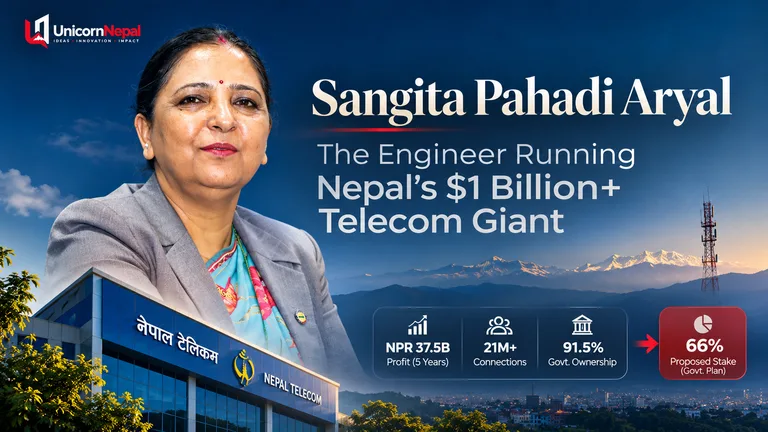
Today, the company behind those numbers is worth approximately $1.2 billion on the stock market. It has generated nearly Rs 37.5 billion in profits over five fiscal years, and the government owns more than 91% of it.
Running this enormous business is Sangita Pahadi Aryal, an engineer who joined Nepal Telecom in 1993, when mobile phones were still a distant possibility for most Nepalis.
And her timing could hardly be more interesting.
From Transmission Towers to the Top Office
Aryal's career began with engineering assignments that rarely attracted headlines.
She has spoken about climbing telecommunications equipment during field postings, pushing into work that women engineers were sometimes discouraged from taking.
Educated in India and Thailand, she spent over three decades moving through Nepal Telecom's technical, wireless and commercial operations.
She became managing director in September 2024, but her tenure took an unexpected turn when she was suspended amid a billing-system procurement case. Following her acquittal by the Special Court, she returned in July 2026.
Her return coincided with an unusual chapter in Nepal's political history.
Following the 2025 Gen Z protests, the country had its first woman prime minister, former chief justice Sushila Karki. A new elected government subsequently took office in 2026.
Aryal's position is not a ceremonial achievement. She is responsible for a publicly listed company that connects millions of people, generates billions in annual revenue and operates infrastructure essential to Nepal's economy.
Her challenge is no longer simply connecting Nepal. It's deciding what Nepal Telecom should become next.
The Billion-Dollar Giant Hiding in Plain Sight
Ncell may attract much of the public conversation, particularly around ownership changes, advertising and regulatory controversies.
But Nepal Telecom has quietly remained one of the country's financial heavyweights.
At a November 13 share price of approximately Rs 940, its market capitalisation stood near Rs 169 billion, or $1.2 billion.
Across the past five fiscal years, Nepal Telecom generated approximately Rs 37.5 billion in cumulative net profit.
Even more remarkably, about 91.5% of the company belongs to the Government of Nepal.
That makes Nepal Telecom an unusual combination: a commercially operating public company, a major government asset and one of the country's most important infrastructure providers.
Its current board is chaired by communications secretary Rajendra Kumar Paudel, with representatives from government institutions, employees and public shareholders.
There is potentially a major ownership change ahead.
The government has proposed reducing its holding to 66%, opening a larger portion of Nepal Telecom to investors. The proposal has not yet translated into a confirmed completed share sale.
For a company of this size, any such transaction would deserve national attention.
Ncell's Billion-Dollar Entry and $50 Million Exit
Here's where Nepal's telecommunications story becomes particularly fascinating.
In 2016, Malaysia's Axiata paid $1.365 billion for an effective controlling interest in Ncell.
In 2023, Axiata agreed to exit through a transaction involving just $50 million in fixed consideration, alongside conditional future payments.
The figures are not directly comparable valuations. The transactions had different terms, and Ncell's subsequent ownership structure, tax disputes and regulatory risks complicate any simple calculation.
Still, the contrast is extraordinary.
While Ncell's ownership battles repeatedly made headlines, Nepal Telecom retained a substantial national subscriber base, significant infrastructure and a record of profitability.
Neither company's visibility tells us which offers better service. But the financial contrast raises a worthwhile question: how often do Nepalis overlook the size of a business simply because it has become part of everyday life?
The Network Behind Nepal's Digital Economy
Nepal Telecom is no longer merely selling calls and SIM cards.
Its infrastructure carries mobile data, fibre broadband, enterprise connectivity and services that power the country's increasingly digital businesses.
When a bank sends a verification code, an online platform notifies its customers, or a company communicates through automated SMS, mobile networks form part of the infrastructure making those transactions possible.
Businesses such as Sparrow SMS and Aakash Digital operate in this ecosystem, connecting organisations to customers through telecommunications services.
But this is also where Nepal Telecom faces its biggest commercial problem.
WhatsApp, Messenger and internet calling have weakened traditional voice and SMS revenue. Customers consume increasing amounts of data, yet that does not automatically translate into equivalent revenue growth.
The opportunity lies in what comes next: reliable nationwide broadband, improved mobile networks, enterprise solutions, cloud infrastructure and eventually wider commercial 5G services.
And the company's investment decisions are already attracting scrutiny.
Proposed billing-system modernisation, a large-scale mobile network replacement project and international bandwidth procurement are among the developments shaping its immediate future.
For Aryal, those decisions will help determine whether Nepal Telecom remains primarily a connectivity provider or becomes a more ambitious digital infrastructure business.
The Engineer's Next Big Test
There is something distinctly Nepali about this story.
An institution that once made customers queue for a SIM card now sits among the country's most valuable listed companies. Its majority shareholder is the government. Its managing director is a woman who began her career working on telecommunications infrastructure more than three decades ago.
But history and scale are no guarantees of future growth.
Nepal Telecom must defend its position against Ncell, respond to changing consumer behaviour, modernise its technology and justify new investments in an industry evolving faster than traditional telecommunications businesses were designed to move.
And Aryal must do so within the governance, procurement and accountability requirements of a government-controlled enterprise.
Nepal Telecom helped give a generation its first phone number. The bigger question now is whether the engineer running it can give the company its next identity.
Financial figures reflect publicly reported information available through November 15, 2026. FY2025/26 earnings are unaudited, and the government's proposed share divestment has not been confirmed as completed.