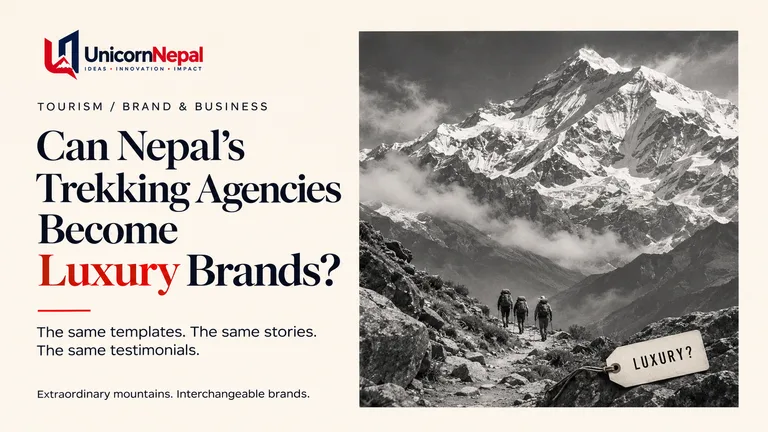
Can Nepal’s Trekking Agencies Become Luxury Brands with the Same Templates, Stories and Testimonials?
Nepal’s mountains command global attention. The commercial challenge is to turn that attention into distinctive experiences, stronger customer relationships and value that remains in the country.
Can Nepal’s Trekking Agencies Become Luxury Brands with the Same Templates, Stories and Testimonials?
Can Nepal’s Trekking Agencies Become Luxury Brands with the Same Templates, Stories and Testimonials?
Nepal’s mountains command global attention. The commercial challenge is to turn that attention into distinctive experiences, stronger customer relationships and value that remains in the country.
A traveller returns from Everest Base Camp with extraordinary photographs, affection for the guide and a five-star review.
But how much of that praise belongs to the company?
Everest supplied the ambition. The Khumbu supplied the landscape. People along the trail supplied the hospitality. An agency can arrange an unforgettable journey while remaining remarkably interchangeable.
Nepal’s Tourism Statistics 2025 lists 3,332 trekking agencies and records US$650.5 million in tourism foreign-exchange earnings in fiscal year 2024/25. In calendar year 2025, Annapurna Conservation Area received 313,549 foreign visitors, while Sagarmatha National Park received 47,524. Those are protected-area entries, rather than counts for specific treks. Everest expedition royalties alone generated approximately US$5.08 million that year, a distinct revenue stream within a much larger mountain economy.
The demand is substantial. The strategic question is how much lasting value Nepal’s companies build from it.
When businesses compete through similar itineraries, familiar founder stories and mounting review counts, price becomes an easy differentiator. The danger is a cycle in which tight margins constrain training and innovation, leaving the experience too interchangeable to support better margins.
Breaking that cycle requires a broader understanding of what a trekking company produces.
Extraordinary scenery does not automatically create pricing power
Nepal’s entrepreneurs have built a functioning mountain economy through difficult terrain, uncertain weather and limited infrastructure. That achievement deserves recognition. It also deserves a business model that rewards more than the ability to move people cheaply.
Elsewhere, landscapes without Himalayan altitude support carefully differentiated travel products. Backroads advertises its Tuscany Active Culinary Hiking & Walking Tour from US$4,599 per person, combining walking with food, villages and hospitality. Mont Blanc Experience lists a nine-day deluxe self-guided journey from €3,395, with accommodation choices, luggage transfers and a digital roadbook. These are advertised package prices, not measures of profit or national tourism revenue, and their costs and inclusions differ from Nepal’s. Their significance lies in what is being packaged and valued.
Travellers pay for the experience constructed around the landscape.
Nepal cannot assume that more dramatic scenery will automatically command a higher price. Nor should it confuse affordability with failure. The missed opportunity arises when a business promises a premium experience while investing primarily in basic fulfilment.
Seven Summit Treks has a recognisable expedition identity. Ace the Himalaya foregrounds responsible tourism and community commitments. Himalayan Glacier draws on a longstanding international presence. These illustrate different approaches to positioning, rather than a ranking of service quality. The opportunity is for more operators to become known for specific expertise.
Nike offers a useful analogy. Research, product development, athlete relationships and storytelling give people reasons to identify with its footwear. Its sports research laboratory makes the investment behind the brand tangible.
For a trekking company, the equivalent might be exceptional guide development, carefully researched routes, reliable equipment and a community of returning mountain travellers. Advertising gains strength when the business gives it something distinctive to communicate.
The hidden cost of dependence is the customer relationship
Overseas tour operators, travel agents, booking platforms and directories bring valuable business to Nepal. They supply distribution, market knowledge and trust. B2B partnerships can support healthy, specialised companies.
Dependence becomes limiting when a local agency receives a passenger list and delivery instructions while the overseas seller retains the richer relationship: why the traveller booked, what alternatives they considered, what they value and where they might travel next.
The local company knows the route. Its partner may know the customer far better.
Commission is only one cost. Limited customer insight can weaken product development, pricing decisions and future demand. An operator may complete hundreds of journeys without learning systematically which experiences its guests would pay more to receive.
Direct bookings can suffer the same weakness when information disappears into a founder’s inbox or a guide’s phone.
A stronger strategy combines productive partnerships with company-controlled records and clear agreements about permissible data sharing, guest communication and brand visibility. Customer relationships must be developed within those agreements and with consent. Direct acquisition should grow through specialist content, referrals and experiences worth seeking out by name.
The economics require scrutiny. What remains from a booking after commission, advertising, staff, accommodation, transport and support? Which channels bring suitable guests? Which generate complaints, referrals or repeat demand?
The 2018 instruction to rank on Google has acquired a 2026 vocabulary of ChatGPT citations and Google AI Overviews. Discovery still matters. Yet another source of inquiries cannot resolve a business model that learns little from the people it serves.
Data capture should begin before the deposit
Passport details and payment records help process a booking. They reveal little about the experience a person hopes to have.
Useful data capture begins with motivation. Is the guest pursuing a physical milestone, photography, Buddhist heritage, family time or an introduction to mountaineering? What concerns them? What pace, comfort and communication do they expect?
At inquiry, the company can record the source of the lead, interests, questions and reasons for choosing or declining. During preparation, it can capture relevant preferences and support needs. During delivery, guides can record service issues and observations through a short, structured process. After departure, private feedback can reveal whether the promise matched the experience.
Those records become valuable when they connect.
A guest interested in architecture should not have to rediscover that interest with a guide who received only a name and room allocation. A dietary requirement should reach the kitchen. A recurring misunderstanding about lodge facilities should change the website and briefing.
The technology can be practical: a customer relationship management system, connected booking records, secure pre-departure forms, scheduled communications and an offline guide brief. Dashboards should answer business questions rather than merely display activity.
Homegrown tools suggest the scope. Trabra presents travel sales and operational tools. Kathmandu-developed GuestSense explores guest preparation and hospitality intelligence. Their relevance is the possibility of developing Nepali software around the realities of Nepali service businesses, rather than assuming that modernisation must always be imported.
AI can organise inquiry themes, summarise conversations, draft multilingual messages and identify repeated complaints. Experienced staff must review cultural interpretation and consequential advice. Nationality is no substitute for asking someone what they prefer.
Privacy belongs within the design. Collect only information needed for a stated purpose. Restrict access to sensitive details, especially health information. Separate marketing permission from operational communication. Set retention periods and choose systems that allow records to be exported.
A guest should experience better care as a result of sharing information. That is the return the company owes them.
Tripadvisor is evidence, but it is not a research department
Review platforms help travellers navigate uncertainty. A strong reputation there can be commercially valuable.
The problem begins when collecting praise becomes the company’s principal method of understanding its customers.
A guest may genuinely love the guide and still find the itinerary rushed. They may describe the mountains as life-changing while finding the agency’s communication poor. A testimonial recorded while arrangements are still in the company’s hands may differ from a private assessment made after returning home.
These possibilities do not invalidate reviews. They explain why review counts cannot substitute for customer research.
Private feedback should ask about the parts of the experience the company controls: preparation, pace, interpretation, accommodation accuracy, equipment, communication and the handling of problems. Guides need a separate channel to report what made delivery difficult. Lost inquiries deserve attention too. Why did interested travellers decide against booking?
The resulting insight should change the product.
If photographers repeatedly feel rushed, test a departure designed around their needs. If first-time trekkers arrive with unrealistic expectations, revise acquisition content and preparation. If guests value a cultural encounter, develop it with the host community and pay fairly for its contribution.
Measure whether the change improves satisfaction, margins and staff workload. Track complaints by departure and supplier. Examine referral bookings, repeat demand and the reasons behind them.
That is an innovation cycle: capture, interpret, test, measure and improve.
An agency that learns from every journey builds knowledge that a competitor cannot obtain by copying its website. A five-star badge helps win attention. Organisational learning determines what happens after the booking.
Nepal’s story is larger than the founder’s struggle
The porter who became a guide and opened an office in Thamel has a story worth telling. It contains work, ambition and knowledge earned in difficult conditions.
As the business succeeds, the story acquires a new question: what changed for the next porter?
The founder’s hardship can explain the company’s origins. Present-day practices must explain its promise. A business operating comfortably in Kathmandu should be able to show how the hardship in its marketing translates into better conditions for people still carrying the work.
The photograph of a child with wind-reddened cheeks requires similar care. A village is a living community with skills, beliefs and aspirations. Its dignity should survive its use in a brochure.
Nepal offers extraordinary narrative depth. Ghandruk’s Gurung heritage, the religious life around Tengboche, and the relationship between Sherpa culture and the Khumbu environment deserve more than a generic reference to “friendly locals”. UNESCO recognises that relationship between people and landscape within Sagarmatha’s significance.
Tenzing Norgay and Edmund Hillary’s 1953 ascent belongs within a longer account of mountain ambition and labour, including generations who maintained trails, carried supplies and sustained settlements. “Sherpa” names a people and a culture whose significance exceeds any expedition service.
An agency can commission local histories, compensate knowledgeable residents, obtain permission to record stories and build an editorial archive. Reviewed material can support guide training, pre-departure reading, audio interpretation and short films.
Communication then becomes a continuous part of the experience. Before arrival, it builds understanding and realistic expectations. On the trail, it reveals meaning. Afterwards, it helps the traveller retain a connection to the people and places encountered.
A blog explaining how many days a trek takes is useful. A body of thoughtful work explaining why the journey matters can establish authority.
The guide delivers the brand and the safety promise
The guide carries the consequences of what the office sold.
If the marketing promises personal attention, cultural depth and reassurance, the guide needs the training, information, authority and time to deliver them. Decent English and familiarity with the route are a foundation.
Training should include interpretation, group dynamics, listening, conflict management, environmental knowledge and relevant emergency competence. Paid preparation, supervised practice, refresher training and post-trip debriefs make that investment repeatable. Guest and guide feedback should reveal where further development is needed.
Reviewed multilingual materials can reduce repetitive translation work. A guide can then devote more attention to the landscape, the group and conversations that cannot be scripted. AI translation should support that expertise, with human review where accuracy matters.
Communication is also an operational discipline. Who updates guests during a flight delay? What has the office promised about accommodation? Who can approve an itinerary change? What happens when mobile coverage fails?
Emergency technology should answer such questions before an incident. Appropriate systems may include offline mapping, tested communication devices, scheduled check-ins, documented escalation procedures and access to qualified medical advice. Equipment requires training, charged batteries, maintenance and a plan for failure.
Satellite communicators illustrate the distinction between buying a device and building a capability. Garmin’s inReach services can provide messaging and SOS coordination with an active subscription, but that subscription does not itself insure the costs of rescue. Local availability and applicable requirements must also be checked.
Insurance deserves the same clarity. Travellers should confirm with their insurers that the activity, maximum altitude, medical treatment and necessary evacuation are covered. Operators should understand the arrangements protecting guides and porters, including how assistance is accessed. Official UK travel guidance for Nepal stresses suitable medical and evacuation cover and warns that rapid helicopter evacuation may be difficult in remote areas.
A helicopter landing nearby is reassuring imagery. Prepared people, workable procedures and clear financial arrangements give the reassurance substance.
Welfare and equipment belong inside the product
An agency announcing that porters carry only 20 kilograms has described one policy. The rest of the working conditions still matter.
Meals, rest, clothing, shelter, insurance and medical support belong in the same assessment. Separate staff accommodation should be judged by its warmth, safety and dignity. Welfare standards must also reach subcontracted workers.
Existing initiatives provide a foundation. The Kathmandu Environmental Education Project’s porter-welfare work and clothing bank demonstrate practical support. The International Porter Protection Group’s guidelines address clothing, shelter, medical care and arrangements for rescue and treatment.
Pack animals deserve equivalent attention. Donkeys, mules and other working animals are part of the supply chain. Appropriate loads, harness fit, rest, veterinary care and treatment on difficult terrain should be explicit conditions when selecting and monitoring suppliers. A sustainability promise should extend to the labour that remains outside the guest’s photograph.
Equipment offers a related opportunity. Kalapatthar’s rental and retail role helps meet an immediate need for mountain gear. Sonam illustrates the scope for building an identifiable Nepali outdoor label around products and positioning. Both contribute value. A trekking company must likewise decide what makes customers prefer its offer beyond immediate availability.
Operators sit on potentially valuable product knowledge. Guides and porters know where boots fail, which straps cause discomfort, how waterproofing performs and what is difficult to repair.
Record those observations. Track equipment condition and retirement. Work with domestic manufacturers on field trials, repair services and improvements suited to local conditions.
Here the Nike analogy becomes tangible. Research and development can begin with disciplined observation on an ordinary departure. Better gear, supported by evidence from its use, gives a homegrown brand a more credible story.
Route innovation can create a wider mountain economy
Route innovation involves more than announcing another “hidden gem”.
It requires understanding who a journey serves, how seasons and conditions affect it, where alternatives exist, what communities want and what the landscape can accommodate. Repackaging a familiar route for a distinct interest can be more valuable than opening a fragile area to poorly planned demand.
A photography departure might allow time for light and observation. A family journey might balance walking with learning and rest. An architectural itinerary through Mustang could involve qualified interpretation of settlement and building traditions. Cultural departures around Ghandruk could be developed with Gurung residents.
The same discipline can support alpine ecology, glaciology, mountaineering history and expedition education. Nepal’s Bachelor of Mountaineering Studies programme demonstrates that an educational foundation already exists. Partnerships with qualified researchers and instructors could connect that expertise with carefully designed travel.
Film production needs location knowledge, permissions and capable coordination. Destination weddings need hospitality, waste planning and local consent. Specialist expeditions need preparation and technical competence. Each offers a different avenue for value, with its own investment and responsibilities.
These opportunities should not become another list of services copied onto every website. An operator must choose where it can develop credible depth.
Customer insight provides direction. Inquiry patterns reveal interests. Guide observations expose delivery constraints. Community consultation establishes acceptable access. Small pilots test the proposition. Commercial results determine whether it deserves expansion.
The potential extends across accommodation, food, equipment, research, creative work and local knowledge. It grows when a company designs a meaningful reason to spend time in a place.
Luxury is the system of care surrounding the view
In Bhutan, Six Senses connects five lodges through a place-based hospitality proposition. In the Alps, Mont Blanc Experience supports journeys with digital route information and differentiated accommodation. Mountain Lodges of Nepal demonstrates a domestic approach to combining trekking and comfort. These examples show different ways of organising value around a landscape.
Hotels provide a useful analogy. Property systems, channel managers and online travel agencies help coordinate supply and sales. The guest experiences the outcome through accurate preparation, personal communication and dependable care. Two beds can meet the same basic need while the stays inspire very different loyalty.
Trekking companies face the same challenge across a longer, less predictable journey.
Technology should connect what was promised with what is delivered. The guest’s preferences should reach the guide. Supplier standards should survive a busy season. Feedback should influence the next departure. A founder’s personal attention should become a dependable organisational practice.
Some improvements require collective action. In 2020, China Mobile and Huawei announced 5G infrastructure on Everest’s northern side, including a base station at 6,500 metres. On Nepal’s routes, mobile and lodge Wi-Fi services, including Everest Link, vary by location and conditions. This is not a current service-quality comparison, but it demonstrates the ambition that mountain infrastructure can attract.
Operators can invest in offline resilience while working collectively on connectivity, trail maintenance, emergency coordination, waste systems and staff facilities. Climate risk belongs in those plans. The 2024 glacial-lake outburst flood that devastated Thame makes clear how closely tourism depends on the security of mountain communities.
For an agency owner, the starting point can be concrete: trace one customer’s journey from first inquiry to post-trip feedback. Identify where information disappears, promises become vague and staff must improvise. Choose one customer group, improve one departure, train the people delivering it and measure the result.
That work connects brand strategy with everyday decisions.
Affordable trekking has immense value. The case for improvement applies at every price. Companies claiming luxury, however, accept a particular obligation to demonstrate what the premium pays for—and where that value goes.
Nepal’s trekking industry has proved it can bring people to extraordinary places. Its next opportunity is to build companies whose expertise, learning and care become part of what travellers came for.
The mountains already have a reputation. Nepal’s trekking brands must earn their own.