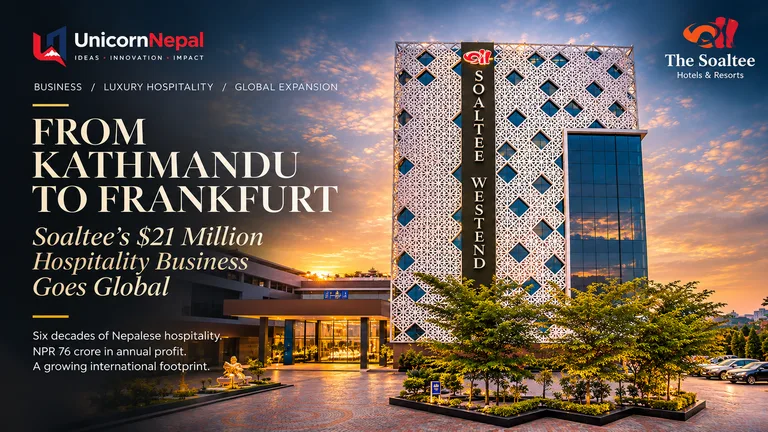
From Kathmandu to Frankfurt: Soaltee's $21 Million Hospitality Business Goes Global
As international luxury hotel brands accelerate their expansion into Nepal, one of the country's oldest hospitality businesses is moving in the opposite direction. With approximately $21 million in annual revenue, $5 million in profit and two branded properties in Germany, Soaltee is turning six decades of heritage into an international business proposition.
From Kathmandu to Frankfurt: Soaltee's $21 Million Hospitality Business Goes Global article' cover image with Ithari Property
From Kathmandu to Frankfurt: Soaltee's $21 Million Hospitality Business Goes Global
As international luxury hotel brands accelerate their expansion into Nepal, one of the country's oldest hospitality businesses is moving in the opposite direction. With approximately $21 million in annual revenue, $5 million in profit and two branded properties in Germany, Soaltee is turning six decades of heritage into an international business proposition.
For much of its modern history, Nepal's luxury hospitality industry has been shaped by international hotel operators bringing their names, expertise and operating standards into the Himalayan nation.
In 1969, Kathmandu's Soaltee Hotel welcomed India's Oberoi Group as an investor and operator, becoming the group's first international venture outside India.
More than half a century later, the direction of travel is changing.
As Marriott, Hilton, Hyatt and other international hotel groups deepen their presence in Nepal, the Soaltee name has appeared above hotel entrances in Frankfurt, Germany—a market thousands of kilometres from the Kathmandu property where its story began.
Behind that expansion is Soaltee Hotel Limited (NEPSE: SHL), whose latest provisional FY2025/26 results show approximately NPR 314.81 crore ($21 million) in revenue and NPR 76.11 crore ($5.1 million) in net profit.
Under Executive Chairman Dinesh Bahadur Bista, the business is pursuing a strategy that extends beyond owning hotel rooms: creating value through hospitality management, partnerships and the commercial strength of the Soaltee brand.
The development raises an interesting question for investors and the wider industry: can one of Nepal's most recognisable hotel names become a commercially valuable international hospitality brand?
From Oberoi to Frankfurt: Six Decades in the Making
Soaltee's beginnings stretch back to 1965, when the foundations of what would become one of Nepal's landmark luxury hotels were established.
In November 1966, the 104-room property was inaugurated in Kathmandu, helping define a new era of premium hospitality in a country whose international tourism industry was still developing.
The arrival of Oberoi in 1969 introduced international operational expertise. In 1975, the International Finance Corporation approved a $3.18 million financing package to support the hotel's expansion, marking IFC's first investment in Nepal.
Soaltee subsequently developed relationships with international hospitality operators, expanded its accommodation and catering businesses, and became the first hotel company listed on the Nepal Stock Exchange in 1993.
Its evolution reflects a broader shift in Nepalese hospitality: from relying on established international names toward building locally recognised brands capable of operating independently.
That legacy now sits alongside substantial financial performance.
Soaltee reported NPR 277.39 crore in revenue and NPR 65.33 crore in net profit in FY2024/25. Its latest provisional FY2025/26 figures indicate revenue increased to NPR 314.81 crore, while net profit reached NPR 76.11 crore.
That represents approximately 13.5% revenue growth and 16.5% profit growth, with the latest reported net margin above 24%.
The company's financial history also includes shareholder distributions. At its 51st Annual General Meeting in December 2025, shareholders approved a 15% bonus share distribution and a 16.5789% cash dividend, calculated against the shares' face value.
But the company's capital is also supporting a different form of growth.
Its 51st Annual Report disclosed NPR 25 crore invested in Soaltee Hospitality Limited, a wholly owned subsidiary, alongside an additional NPR 1.264 crore advanced toward equity.
The investment is significant because it provides a corporate structure through which Soaltee can participate in hospitality ventures beyond its flagship property.
Bista provides executive leadership at the listed company, while Vice President Sudarshan Chapagain has represented Soaltee in expanding its hotel management relationships.
For a business with six decades of history, the emerging strategy is not to abandon its roots, but to make its experience and reputation commercially relevant in new markets.
The Two-Way Luxury Trade: Nepal Welcomes the World as Soaltee Heads Abroad
Nepal's luxury hospitality market is entering an increasingly competitive period.
Hilton has established its presence in Kathmandu, while Marriott and Hyatt already operate internationally branded properties in the country.
In June 2026, Marriott International and CG Hospitality Global announced plans for The Ritz-Carlton Kathmandu and The Westin Kathmandu, with openings targeted for 2031.
Meanwhile, Indian boutique luxury operator The Postcard Hotel, founded by former Oberoi Group president Kapil Chopra, announced its entry into Nepal through a 22-room-and-suite property in Chitwan.
These developments illustrate the growing international appetite for Nepal's hospitality market, from urban business travel to exclusive wilderness experiences.
Soaltee's international ambitions represent the other side of that movement.
In January 2025, Soaltee Westend Messe Frankfurt, a 50-room property, began operating under the Nepalese brand. A second property, the 236-room Soaltee Westend Premier Messe Frankfurt, followed in March.
Together, the two properties represent a 286-room branded presence in Germany.
The expansion was structured through hotel service agreements involving Stream Peak International, an associated hospitality venture, and German hotel operators within the Trip Inn Group.
Importantly, the arrangement does not mean Soaltee Hotel Limited purchased two hotels in Frankfurt.
Instead, the European development illustrates a business model increasingly familiar across global hospitality: expanding brand presence through management, operating and licensing arrangements rather than relying exclusively on hotel ownership.
For a company with international ambitions, that distinction can be economically significant. Management and licensing relationships can allow a brand to expand without committing the capital required to purchase or construct every property.
The same philosophy is visible in Soaltee's domestic portfolio.
In February 2026, the 51-room Soaltee Westend Resort Manakamana began operations near one of Nepal's major religious tourism destinations.
In June, Soaltee signed an agreement with Classic View Resort Limited to manage The Soaltee Resort Shivapuri National Park Kathmandu, which has 25 rooms and a private villa, with 51 additional rooms under development.
In eastern Nepal, Soaltee Westend Itahari, operated by Garima Hotel Limited under a franchise arrangement, reported NPR 20.7 crore in FY2025/26 revenue and NPR 8.2 crore in EBITDA.
Those Itahari figures belong to the hotel operator, not automatically to Soaltee Hotel Limited's income statement.
This distinction is central to understanding the broader business.
A hotel may carry the Soaltee name without the publicly listed company owning the property or receiving its entire operating revenue.
For investors, the value lies in the management fees, royalties, investment interests and earnings that can ultimately be attributed to Soaltee's shareholders.
In an industry where international operators have long relied on these arrangements, Soaltee is attempting to build its own platform around a Nepalese hospitality identity.
Beyond the Hotel: What Is Soaltee Worth to Investors?
The market already assigns considerable value to Soaltee.
At a share price of NPR 545 on November 10, 2026, Soaltee Hotel Limited carried an estimated market capitalisation of approximately NPR 6,405 crore, or roughly $426 million at an illustrative exchange rate of NPR 150.3 per dollar.
That makes the company's market valuation substantially larger than its annual revenue.
Using its latest reported annual profit of NPR 76.11 crore, the market valuation implies a price-to-earnings multiple of approximately 84 times earnings.
The figure does not establish that shares are overvalued or undervalued. It does, however, reveal the importance investors may place on the company's reputation, property assets, financial performance and future growth.
It also raises a question that international expansion alone cannot answer: how much additional profit can Soaltee generate from its growing hospitality network?
The company's reported NPR 76.11 crore annual profit demonstrates the strength of its established operations.
But the earnings contribution of the Frankfurt management and licensing arrangements has not been disclosed in sufficient detail to independently determine their financial significance to the listed company.
Nor should every new Soaltee-branded property's revenue be counted as revenue earned by Soaltee Hotel Limited.
While the international strategy creates opportunities for potentially less capital-intensive growth, its financial success will depend on actual management income, licensing fees, investment returns and the costs of supporting a wider portfolio.
The Kathmandu flagship remains important too.
The company's 51st Annual Report outlined upgrades to accommodation, conferencing facilities and parking infrastructure, reflecting continued investment in the property that established its reputation.
Hospitality also remains exposed to changes in occupancy, room pricing, travel demand and operating expenses.
For investors, Soaltee's next phase therefore involves two parallel tests: preserving profitability at its established operations and demonstrating that a wider branded network can produce meaningful additional earnings.
There is a larger industry story here as well.
Nepal's hospitality sector has spent decades developing through international relationships, foreign investment and the arrival of globally recognised operators.
Soaltee benefited from that model early in its history. Today, it is experimenting with what happens when a Nepalese hospitality institution becomes the brand entering an overseas market.
Frankfurt is not proof that Soaltee has become a global hotel giant. Nor does a European address automatically translate into a successful international business.
But it represents an important strategic milestone for a company whose origins are inseparable from Nepal's modern tourism history.
Sixty years ago, the world brought luxury hospitality expertise to Soaltee in Kathmandu. Today, Soaltee is taking a Nepalese hospitality name to the world.
The next chapter will be determined not by how far that name travels, but by how much value it creates along the way.