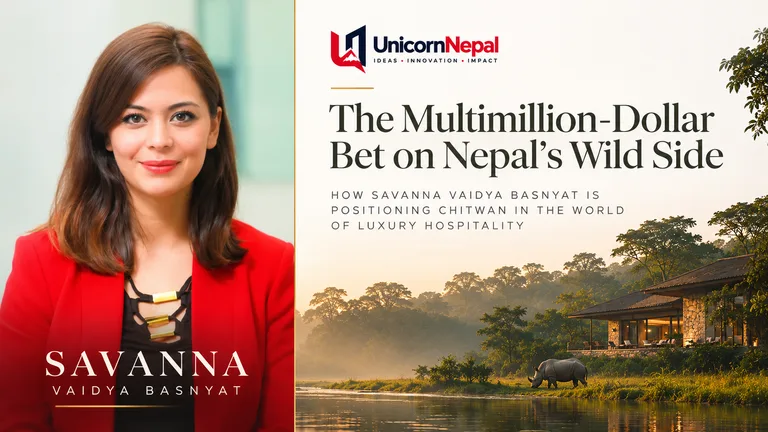
Savanna Vaidya Basnyat and the Multimillion-Dollar Bet on Nepal's Wild Side
With a reported NPR 500 million development investment, a partnership with former Oberoi president Kapil Chopra's The Postcard Hotel, and an ambition extending beyond a single luxury retreat, Savanna Vaidya Basnyat is helping write a new chapter in Nepal's high-end hospitality story.
Savanna Vaidya Basnyat and the Multimillion-Dollar Bet on Nepal's Wild Side
Savanna Vaidya Basnyat and the Multimillion-Dollar Bet on Nepal's Wild Side
With a reported NPR 500 million development investment, a partnership with former Oberoi president Kapil Chopra's The Postcard Hotel, and an ambition extending beyond a single luxury retreat, Savanna Vaidya Basnyat is helping write a new chapter in Nepal's high-end hospitality story.
Some of the world's most desirable luxury destinations are defined not by what has been built around them, but by what remains untouched.
For Savanna Vaidya Basnyat, that distinction became the foundation of a multimillion-dollar hospitality venture along the Rapti River in Chitwan, Nepal.
The property, The Postcard on the Rapti River, is preparing to welcome guests in November 2026. With just 22 rooms and suites, an internationally recognised boutique hospitality partner, and reported development investment of approximately NPR 500 million, it represents a substantial commitment to a different kind of Nepalese tourism.
Behind the project is a young business leader from one of Nepal's established industrial families, making a calculated move into the increasingly competitive world of destination-led luxury.
And her choice of location reveals as much about the ambition as the investment itself.
An Heir to Enterprise, an Architect of Ambition
The Vaidya name has been part of Nepal's business landscape for more than six decades. The family's enterprise, Vaidya's Organization of Industries and Trading Houses (VOITH), built its reputation through automobiles, industrial trading and investments, including its longstanding association with Toyota.
Savanna, daughter of group president Suraj Vaidya, represents the family's next generation. As Director of VOITH Hospitality, she is helping steer its expansion into a sector quite different from the businesses that established the family's commercial reputation.
The Chitwan venture began with a particular stretch of riverfront in Meghauli, overlooking the forests bordering Chitwan National Park.
Savanna and her father spent years developing the property, pursuing an approach in which the architecture and guest experience would respond to the surrounding wilderness rather than overwhelm it.
Her publicly stated motivation goes beyond building a luxury resort. She wants international travellers to discover Nepal's Terai, a region often overshadowed by the country's Himalayan identity.
The challenge is turning that conviction into a business capable of attracting some of the world's most discerning travellers.
The Price of a Bigger Vision
In December 2023, Nepalese business publication Capital Nepal reported that approximately NPR 50 crore (NPR 500 million) was being invested in Sasvata Wildlife Resort, the development that would become The Postcard on the Rapti River.
At the time, construction was reportedly 60% complete.
Spread across ten bighas of riverfront land, the property has just 22 accommodation units. Using the reported development budget, that represents approximately NPR 2.27 crore per room or suite, although the calculation includes the cost of shared facilities, infrastructure and the wider development.
That is an indication of capital intensity, not a measure of individual room construction costs.
The commercial proposition becomes more intriguing when viewed alongside the hotel's announced starting rate of INR 85,000 per suite per night.
At that price point, the business is competing for affluent international travellers who are prepared to pay for privacy, exclusivity and exceptional experiences.
Yet high room rates alone do not guarantee attractive returns. Occupancy, seasonality, operating costs and access to international luxury travel networks will ultimately determine whether the investment performs.
Neither the property's final development expenditure nor its projected returns have been publicly disclosed.
For Savanna, the real financial test will be whether a relatively small inventory can command sufficient demand to justify the capital committed to creating it.
Where Legacy Meets the Art of Hospitality
Rather than introducing the resort under an entirely independent identity, Savanna's team partnered with The Postcard Hotel, the Indian boutique luxury brand established in 2018 by Kapil Chopra, formerly president of the Oberoi Group's Indian operations.
The partnership was formalised in December 2023.
Unlike multinational hotel groups pursuing extensive portfolios of standardised properties, The Postcard has built its identity around intimate hotels, personalised hospitality and distinctive destinations.
By November 2026, it reported 13 operating properties across India, Bhutan and Sri Lanka, with Chitwan marking its entry into a fourth country.
Its appeal was not simply the prestige of an international name. The brand's philosophy closely matched Savanna's vision of an experience shaped by its natural setting.
Chopra has publicly credited the conviction of Savanna and her father as a reason the company was drawn to the project.
For the Vaidya family, the arrangement connects Nepalese property development with an established luxury operator's hospitality expertise and brand positioning. For The Postcard, it offers entry into Nepal through a locally backed development.
The companies have not publicly disclosed the financial terms of the agreement, including any direct equity participation by The Postcard.
It is an important distinction: an international brand entering Nepal does not necessarily mean it is financing the underlying real estate.
What the partnership demonstrates is how established Nepalese businesses can use international hospitality expertise to position locally developed assets for global clientele.
Beyond the Himalayas, a Different Kind of Luxury
Chitwan has a luxury hospitality history stretching back decades. From the pioneering Tiger Tops experience to Meghauli Serai, developed by Nepal's Chaudhary Group and operated by Taj Safaris, the region has already attracted investors seeking a share of the premium wildlife tourism market.
Savanna is entering an established category, not inventing one.
Her opportunity lies in positioning the Rapti River property within a particularly exclusive segment of that market.
Bordering the buffer zone of UNESCO-listed Chitwan National Park, the retreat brings together riverfront accommodation, naturalist-led safaris, birdwatching, wellness and encounters with the cultural heritage of the indigenous Tharu community.
Its suites offer substantial private spaces, while the surrounding forests are home to greater one-horned rhinoceroses, Bengal tigers and hundreds of bird species.
There is a distinctive proposition here: an experience of South Asian wilderness with the intimacy and service associated with the world's finest boutique retreats.
But the luxury promise carries a responsibility.
Conservation tourism must ultimately deliver more than attractive views and environmental language. Its long-term credibility depends on responsible operations, community participation and the protection of the ecosystems on which the business depends.
For Savanna, that balance could become as important to the property's reputation as its architecture or nightly rates.
A New Address for Nepalese Luxury
The Chitwan venture may be the beginning of a broader hospitality chapter for the Vaidya family.
VOITH Hospitality has outlined plans for Himalayan Sasvata, a mountain lodge in Phakding along the Everest trekking route, as well as Golden Thread, a proposed platform connecting travellers with experiences across Nepal.
Both remain in development, but together they suggest an interest in building a portfolio around Nepal's geographical and cultural diversity rather than concentrating solely on conventional hotel destinations.
Savanna's immediate challenge, however, remains the one on the Rapti River: transforming a substantial investment, years of development and an international brand partnership into a sustainable luxury business.
For Nepal's hospitality industry, the venture adds another example of domestic capital working with an international operator to compete for high-value travellers.
For Savanna, it presents something more personal: an opportunity to establish her own identity in a family known for building businesses across generations.
The world's attention may still be drawn first to Nepal's mountains. But if this investment succeeds, it could strengthen the case for a different kind of luxury journey, one measured not in altitude or distance, but in intimacy, wilderness and the experience of a place.
And on a quiet bend of the Rapti River, Savanna Vaidya Basnyat is betting that the world will find that journey worth taking.