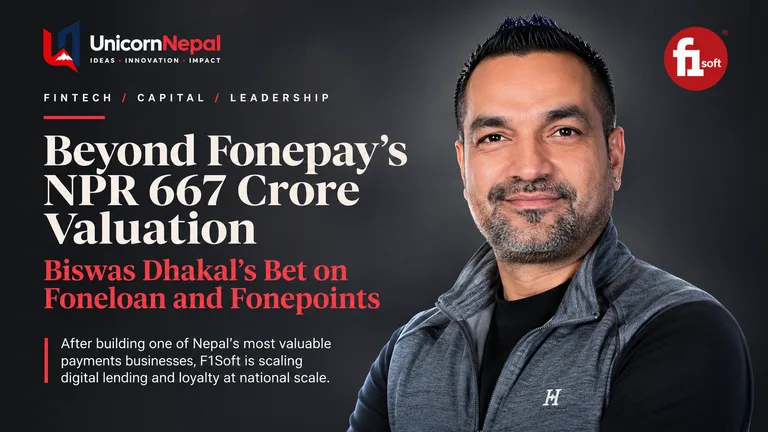
After a minority share sale brought Rajendra Khetan and institutional investors into Fonepay, Biswas Dhakal's F1Soft is looking beyond payments. With Foneloan facilitating more than 320,000 loans and Fonepoints reaching 2.2 million customers, the Nepalese fintech group faces a bigger test: can it build another business as valuable as Fonepay?
After a minority share sale brought Rajendra Khetan and institutional investors into Fonepay, Biswas Dhakal's F1Soft is looking beyond payments. With Foneloan facilitating more than 320,000 loans and Fonepoints reaching 2.2 million customers, the Nepalese fintech group faces a bigger test: can it build another business as valuable as Fonepay?
In September 2025, one of Nepal's most established financial technology groups made a decision that revealed more about its future than its past.
F1Soft sold a 14.37% stake in Fonepay, a payments network that had become a cornerstone of Nepal's digital economy. The sale was part of a broader NPR 149 crore transaction that valued Fonepay at approximately NPR 667 crore.
Industrialist Rajendra Khetan emerged as the largest individual buyer, acquiring 14% personally, while another 1% went to his affiliated Rapid Investment.
But for F1Soft, the more consequential decision was on the selling side.
Its portion of the transaction carried an implied value of approximately NPR 96 crore. Co-founder Subash Sharma explained that the group needed resources to develop newer ventures, specifically naming digital lending business Foneloan and loyalty platform Fonepoints.
A year later, both ventures have achieved substantial operating scale. Foneloan reports more than 320,000 loans facilitated, while Fonepoints has built a rewards network serving over 2.2 million customers.
The numbers suggest something bigger than a company diversifying its product portfolio.
After two decades building financial infrastructure for Nepal's banks and consumers, Biswas Dhakal's F1Soft is testing whether it can repeatedly create, scale and monetise valuable fintech businesses.
That is a different ambition from simply operating a successful payment network.
The NPR 149 Crore Deal: Who Sold, Who Bought, Who Won?
Founded in 2004, F1Soft grew from a Nepalese software venture into a financial technology group spanning banking infrastructure, digital payments, remittances, lending and loyalty services.
Its portfolio includes eSewa, Fonepay, FoneNXT, Foneloan and Fonepoints, alongside its established banking software business.
The group's early growth was closely associated with founder Biswas Dhakal and co-founder Subash Sharma, who helped develop products that became integral to Nepal's transition towards digital banking.
By 2025, Fonepay had become an asset substantial enough to attract established business families and investment funds.
The September transaction transferred a reported 22.37% of Fonepay's shares for approximately NPR 149 crore.
Two shareholders supplied those shares.
F1Soft sold 14.37 percentage points, while technology entrepreneur and early investor Asgar Ali sold another 8 percentage points.
On the buying side, Khetan personally acquired 14%, with Rapid Investment taking an additional 1%.
At the reported valuation, those holdings represented approximately NPR 93.38 crore and NPR 6.67 crore respectively, giving Khetan-linked investors a combined implied investment value of roughly NPR 100 crore.
The remaining buyers included Nepal Impact Fund One, Nepal Infrastructure Fund, Nepal Impact Global Equity Fund One, Parsa Holdings, Sweda Investment, Laxmi Micro Investment, GGC Investments and other investors.
The financial distinction is important.
Khetan's estimated NPR 100 crore exposure represents the value of his affiliated share acquisitions, not money invested directly into Foneloan or Fonepoints.
Similarly, F1Soft's 14.37% disposal implied proceeds of approximately NPR 95.85 crore, but the amount it actually received after transaction adjustments has not been independently established.
The transaction was principally a secondary share sale, meaning the money went to existing shareholders rather than automatically becoming new capital for Fonepay.
Nor has F1Soft disclosed how much of its proceeds was subsequently invested in its newer businesses.
For Khetan, the acquisition was consistent with his growing financial-sector interests.
He had also increased his ownership in Laxmi Sunrise Bank to approximately 7.5%, following a reported NPR 126 crore purchase of promoter shares earlier in 2025. His broader investments include insurance, banking and financial services.
His entry into Fonepay therefore extended an existing investment strategy rather than marking an isolated technology investment.
For F1Soft, the sale had a different purpose.
Sharma publicly explained that the group was raising resources to develop its newer ventures and wanted to grow them into businesses comparable in scale to eSewa.
That makes the transaction an example of capital recycling: releasing part of the value created in one established company while retaining ownership and pursuing new opportunities elsewhere.
F1Soft's leadership has also evolved.
In 2025, Dhakal moved into the group chairmanship, with Siddhant Thakuri becoming group president. Sharma continued in corporate strategy, while Sanat Kumar Paudel, previously involved in digital transformation at Nabil Bank, became CEO of F1Soft International in April 2026.
Fonepay itself is chaired by veteran banker Sashin Joshi and led operationally by CEO Diwas Sapkota.
These appointments reflect an increasingly specialised management structure across the group's businesses.
The central question, however, remains financial: can F1Soft turn the value created by its earlier products into attractive returns from the next generation?
Fonepay's Numbers: The Business Behind the Valuation
Fonepay's investment appeal is rooted in infrastructure rather than consumer recognition alone.
The company operates an interoperable payment network connecting banks, financial institutions, merchants and digital wallets.
In September 2025, it was reportedly processing approximately 1.8 million transactions daily, comprising around 1.3 million QR payments and 500,000 interbank fund transfers.
The combined daily transaction value was approximately NPR 18 billion.
Today, Fonepay reports relationships with more than 60 banks and financial institutions, connections to more than 20 million customers and a merchant network exceeding 1.7 million locations.
The scale is significant, but the company's financial statements offer a more useful measure of its commercial performance.
Fonepay's annual revenue increased from NPR 20.6 crore in FY2022 to NPR 44.2 crore in FY2023, followed by NPR 72.7 crore in FY2024 and approximately NPR 97.4 crore in FY2025.
That represents revenue growth of more than fourfold across three years.
In the first six months of FY2025/26, revenue reached NPR 61.1 crore, reportedly 26% higher than the comparable period a year earlier.
Profitability makes the valuation more interesting.
New Business Age reported FY2024/25 revenue of NPR 97.32 crore and a 32.4% net profit margin, implying approximately NPR 31.5 crore in annual net profit.
Against the NPR 667 crore private transaction valuation, that suggests an implied price-to-earnings multiple of approximately 21 times FY2025 profit.
The calculation provides useful context for potential investors, although it relies on reported financial figures rather than an independently verified valuation report.
Fonepay's massive transaction volumes should not be confused with earnings.
The trillions of rupees flowing through its infrastructure largely belong to customers and participating institutions. Fonepay earns income through the services it provides, not by retaining the underlying transaction value.
Its commercial importance is also broader than the familiar QR code.
As CEO Diwas Sapkota has explained, Fonepay operates largely behind participating banks, enabling services such as transfers, merchant payments and other payment functions within existing financial applications.
That infrastructure is also becoming internationally connected.
Fonepay's UPI integration, introduced for cross-border payments with India, enabled eligible Indian visitors to make payments at participating Nepalese merchants.
In September 2025, the company announced a partnership with Alipay+, the international payments platform operated by Ant International, to broaden access for travellers using supported Asian digital wallets.
A further integration with UnionPay International in May 2026 expanded QR acceptance for eligible users from markets including mainland China, Hong Kong, Macau and Singapore.
The UnionPay announcement described access to more than two million participating merchants across Nepal.
These partnerships matter in a tourism-dependent economy where foreign visitors increasingly expect familiar digital payment options.
They also position a Nepalese financial technology network within an increasingly interconnected Asian payment ecosystem.
Nevertheless, international reach does not automatically translate into international profits. Fonepay has not publicly disclosed a sufficiently detailed breakdown showing how much revenue or margin comes from these cross-border arrangements.
The next major financial milestone may be its planned public offering.
Fonepay has been pursuing an IPO through a book-building process, potentially establishing a public-market valuation distinct from the NPR 667 crore figure implied by the 2025 private transaction.
For F1Soft and Khetan-linked shareholders alike, that could provide another benchmark for the value of their remaining investments.
It is not, however, a guaranteed investment return. Any eventual gain would depend on the offering price, future market valuation, shareholder restrictions and the actual purchase cost.
Foneloan and Fonepoints: The Two Businesses F1Soft Wants to Scale
The next stage of F1Soft's expansion is taking shape in two different financial technology markets.
One is credit. The other is loyalty.
Both have developed beyond their initial stages, but they operate through fundamentally different business models.
Foneloan, led by CEO Sagar Sharma, provides digital lending technology through participating financial institutions.
Rather than functioning as a conventional bank, the platform enables banks to offer eligible customers pre-approved, collateral-free loans through their existing mobile banking applications.
F1Soft's published metrics show more than 100,000 users, 320,000 loans facilitated and cumulative lending volume exceeding $57 million.
Partner institutions include Nabil Bank, Kumari Bank, Laxmi Sunrise Bank, NIC Asia Bank and Prabhu Bank.
In February 2026, Foneloan announced a partnership with state-owned Rastriya Banijya Bank, expanding access to eligible salary-account customers through the bank's digital banking platform.
The company has also developed instalment-based lending and buy-now-pay-later offerings.
Its commercial advantage potentially lies in distribution.
Instead of independently acquiring every borrower, Foneloan can work through financial institutions that already have customer relationships, banking infrastructure and regulated lending capabilities.
The model resembles the broader global movement towards embedded finance, where financial products are delivered through platforms and applications customers already use.
But the economics require careful interpretation.
The $57 million figure represents loan principal facilitated through the technology, not Foneloan's revenue. Credit risk generally sits with partner lending institutions, subject to their specific arrangements.
For investors, the more important metrics would be platform fees, recurring bank contracts, servicing revenue, customer retention and the cost of maintaining the technology.
Those figures have not been sufficiently disclosed.
Fonepoints, led by CEO Sagar Paudel, is targeting a different opportunity: the commercial value of customer engagement.
Its loyalty platform allows customers to collect rewards through eligible transactions and redeem them across participating merchants and services.
According to its published website metrics, Fonepoints has reached approximately 2.21 million customers, 3,096 redemption partners and 1,821 active offers.
Its ecosystem includes dining, travel, shopping and other consumer services.
The platform has also built a direct relationship with Fonepay, enabling eligible payment activity to generate redeemable rewards.
For merchants, this offers another channel for reaching customers and encouraging repeat purchases. For banks and payment platforms, rewards can strengthen the value of their existing digital relationships.
Globally, loyalty technology has evolved into a business category extending well beyond promotional points, encompassing customer retention, merchant marketing and software infrastructure.
Fonepoints could pursue parts of that opportunity in Nepal.
But two million registered customers do not necessarily equal two million active customers.
Without data on monthly active users, annual redemptions, revenue per customer, merchant retention and operating profit, its commercial value remains difficult to measure.
The same uncertainty applies to Foneloan.
Both businesses have existed for years, and both were operational before F1Soft's September 2025 Fonepay share sale.
Their reported scale demonstrates market adoption. It does not prove that the proceeds of the transaction caused their growth.
What the numbers do show is that F1Soft's next ventures are no longer merely ideas awaiting investment.
They are operating businesses with substantial banking, consumer and merchant relationships.
The challenge now is turning that reach into durable and measurable earnings.
Beyond Nepal: Can F1Soft Build a Repeatable Fintech Business Model?
F1Soft's development offers a distinctive example of how a technology company from a relatively small financial market can expand across related services.
The group began with financial software and evolved into a portfolio that now includes banking infrastructure, digital wallets, payment networks, remittances, digital lending and loyalty technology.
It reports more than 50 banking and financial institution partners, technology reaching over 26 million users and a workforce exceeding 1,200 people.
Its operations are centred in Nepal, with a business presence in Dubai supporting ambitions beyond the domestic market.
Under Sanat Kumar Paudel's leadership, F1Soft International has also publicly identified international expansion as part of its longer-term strategy.
These ambitions place the group within a global financial technology trend in which infrastructure providers increasingly serve multiple financial needs through interconnected platforms.
F1Soft's competitive opportunity is not simply that it has developed several applications.
It is that the group has spent more than two decades building relationships with regulated financial institutions, delivering technology at scale and establishing consumer-facing platforms that operate within the same financial ecosystem.
That institutional access could make it easier to introduce related services.
The relationship between these businesses, however, is not automatically equivalent to a single integrated financial platform. Their ownership structures, customer data arrangements, governance and financial performance need to be assessed separately.
The valuation question is equally important.
Fonepay's NPR 667 crore transaction valuation belongs to Fonepay, not the entire F1Soft Group.
Similarly, the implied NPR 96 crore value of F1Soft's disposed stake is not evidence that the same amount was invested in Foneloan and Fonepoints.
And the combined implied NPR 100 crore value of Khetan-linked Fonepay holdings is not evidence of his ownership in those newer ventures.
These distinctions are essential to understanding who created value, who received capital and which shareholders may benefit from future growth.
F1Soft's broader valuation would require a more complete picture of its subsidiary holdings, revenue, profitability, debt, investment commitments and minority interests.
It would also require answers to questions that remain undisclosed: how much capital has actually been committed to Foneloan and Fonepoints, whether either business is profitable, and what returns they have generated for their shareholders.
For Nepal's technology sector, the significance extends beyond one group.
Building a scalable financial technology company is difficult. Creating several, attracting outside capital and reinvesting proceeds into the next generation represents a more demanding test of management and capital allocation.
F1Soft has already demonstrated that Nepalese technology infrastructure can support tens of millions of users, process substantial transaction volumes and attract sophisticated investors.
Its next challenge is less about proving that digital finance can achieve scale in Nepal.
It is about proving that scale can be converted into repeatable financial value.
Fonepay has provided the first significant benchmark.
Foneloan and Fonepoints may determine whether Biswas Dhakal's F1Soft can build on it.
The NPR 667 crore valuation tells us what investors were willing to pay for Fonepay. The next chapter will reveal what F1Soft can create with the capital, relationships and experience it has accumulated.