
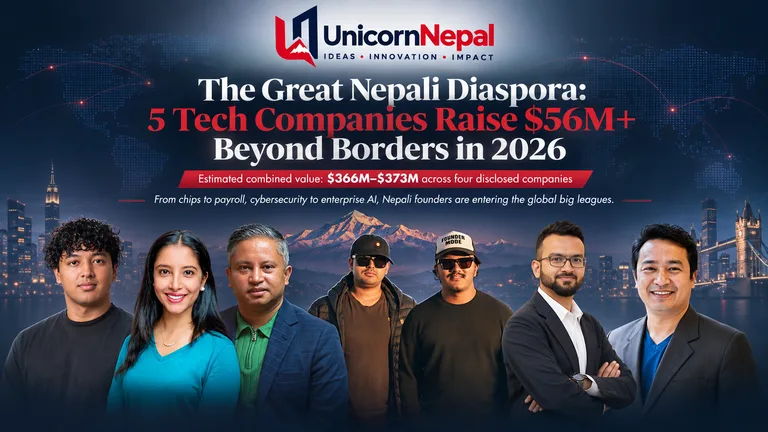
The Great Nepali Diaspora: 5 Tech Companies Raise $56M+ Beyond Borders in 2026
An estimated $366M–$373M in combined value across four companies. The fifth, Architect Labs, has yet to disclose its valuation.
From AI-designed semiconductors to global payroll and cybersecurity, Nepali founders are attracting serious international capital. Their companies are entering markets dominated by Silicon Valley giants, with ambitions that stretch far beyond Nepal's borders.
For decades, the world has known Nepal for Everest, Gurkhas and an extraordinary number of people willing to build careers far from home. It may be time to add another export to that list: technology founders.
Consider what happened in 2026.
A Nepali co-founder secured $24 million to rethink semiconductor design. A New York fintech with Nepali founders attracted another $21 million while reporting more than $30 million in recurring revenue. Another team emerged from Y Combinator with an AI product for education. In India, a cybersecurity business with Nepali roots entered the stock market. And a pioneering enterprise AI company, built partly on Nepal's engineering talent, continued its journey on Nasdaq.
Together, Architect Labs, Niural, Lamina Labs, Kratikal Tech and Fusemachines account for approximately $56 million in reported financing, spanning venture investment, public equity and convertible debt.
These are five very different bets. Some have paying enterprise customers. One is profitable. Another is burning cash. Their technologies range from the chips powering AI to the financial infrastructure running international businesses.
What makes them interesting is not where their founders were born. It is the size of the problems they have chosen to solve.
Architect Labs: Taking AI Into the Chipmaking Business
$24M Seed Funding | Palo Alto, California | Semiconductors
Everybody wants a piece of the AI boom. Far fewer companies are prepared to tackle the machinery underneath it.
Designing advanced semiconductors remains brutally expensive. Companies such as Nvidia, Broadcom and Marvell operate in an industry where sophisticated engineering programmes require enormous capital, specialised talent and years of development.
Aaditya Subedi, alongside co-founder Ebrahim Hussain, sees an opportunity in that complexity.
Their company, Architect Labs, is developing AI-powered methods to design specialised chips, potentially reducing the time and engineering effort required to develop custom silicon.
In June, it raised $24 million, led by Kindred Ventures, with Race Capital, TQ Ventures and Together Fund joining the round.
The investor list carries unusual weight. Google DeepMind's Jeff Dean, alongside individuals associated with Nvidia and OpenAI, participated as angel investors.
These are personal investments, not proof that the companies themselves are customers.
Architect Labs says it is already working with semiconductor partners, although it has not publicly named them or disclosed revenue.
Its next test is significant: proving that AI-generated chip designs can perform reliably in an industry that leaves little room for error.
For Subedi, this is an entrance into one of technology's most technically demanding markets. For investors, it is a bet that the next wave of AI innovation may transform how the underlying hardware gets built.
Niural: The Nepali-Founded Fintech Challenging Global Payroll
$21M New Funding | New York | Fintech and Enterprise AI
Hiring internationally has become easier. Paying everyone correctly remains a headache.
Different currencies, local taxes, employment laws, benefits and compliance obligations turn international payroll into an expensive operational exercise.
Nami Baral and Nabin Banskota, alongside their fellow co-founders, built Niural to tackle that problem.
Its AI-powered platform brings payroll, payments, employment compliance and benefits into one system. It is entering territory occupied by well-funded competitors such as Deel, Rippling and ADP.
The company received another $21 million in 2026, with investors including FOG Ventures and NewView Capital, bringing its extended Series A to $52 million. Earlier backers include Marathon Management Partners, M13 and Inspired Capital.
Niural's customers include Polygon, ConductorOne, Rillet and Sevaro. Its benefits ecosystem also connects with insurers such as Aetna and Kaiser Permanente.
But the most interesting numbers are coming from the business itself.
According to The Information, Niural surpassed $30 million in annual recurring revenue, with gross margins above 85% and an estimated valuation of $325 million.
That is not a disclosed net profit figure. It is, however, evidence of meaningful commercial scale.
Niural is arguably the strongest private-company commercial performer in this group. Its advantage will depend on whether it can keep expanding while maintaining reliable financial and compliance infrastructure across jurisdictions.
Lamina Labs: Can AI Make a Physics Lesson in Seconds?
$4.8M Reported Funding | San Francisco | Generative AI
Ask AI to write an explanation of Newton's laws, and it will produce paragraphs in seconds.
Ask it to create an accurate animated lesson, complete with moving objects, narration and scientific diagrams, and the challenge becomes considerably harder.
That is the opportunity Sudip Rokaya and Kartikesh Mishra are pursuing through Lamina Labs.
Their product, Simi, generates explanatory videos from written instructions and documents, targeting education, technical training and content production.
The company joined Y Combinator's 2026 cohort and reported $4.8 million in funding, with backing including Foundation Capital and Link Ventures.
Early traction was encouraging: approximately 4,000 users and 187 paying customers within 12 days of launch, according to founder-linked reporting.
Its estimated enterprise value stands between $12 million and $18 million, although major enterprise customers and recurring revenue figures have not been publicly established.
Lamina is entering a generative AI market where product advantages can disappear quickly. OpenAI, Google and other major developers are constantly expanding their capabilities.
The company's opportunity lies in doing something more specialised than generating attractive video: producing explanations accurate enough for teachers, engineers and businesses to trust.
If it succeeds, a small Nepali-founded team could become part of the technology infrastructure behind how people learn.
Kratikal Tech: A Nepali Co-Founder Reaches India's Stock Market
₹39.69 Crore IPO | Noida, India | Cybersecurity
Hackers don't always need sophisticated software. Sometimes, a convincing email is enough.
That vulnerability helped create a business opportunity for Dip Jung Thapa, a Nepali entrepreneur from Khotang who co-founded Kratikal Tech with Pavan Kumar Kushwaha and Paratosh Kumar Bansal in 2013.
Kratikal develops cybersecurity products and services for enterprises. Its Threatcop platform simulates phishing attacks and trains employees to recognise threats, while its wider portfolio covers security testing, compliance and automated assessments.
The company operates primarily in India, with international business spanning markets including the United States and the Middle East.
In July 2026, Kratikal raised ₹39.69 crore, approximately $4.2 million at the November exchange rate used here, through an IPO on India's BSE SME platform.