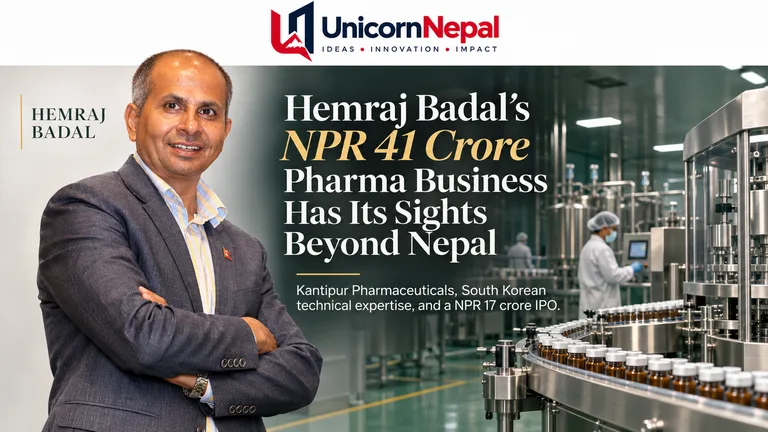
Hemraj Badal's NPR 41 Crore Pharma Business Has Its Sights Beyond Nepal
With NPR 40.88 crore in annual revenue, NPR 77.45 crore in reported net worth and a NPR 17 crore IPO approved, Kantipur Pharmaceuticals is looking beyond Nepal through South Korean technical expertise and ambitions to enter international markets.
The next chapter of Nepal's pharmaceutical manufacturing industry may be taking shape not in a major industrial capital, but in Panchkhal, a municipality in the hills east of Kathmandu.
There, Kantipur Pharmaceuticals Lab Limited (KPL) has built a veterinary medicine and animal nutrition business generating nearly NPR 41 crore in annual sales.
Its chairman, Hemraj Badal, now stands at the intersection of three developments: an expanding domestic manufacturing operation, a technical partnership with South Korea's KBNP, and regulatory approval for a NPR 17 crore initial public offering.
The company's revenue grew approximately 80% in FY2025, reaching NPR 40.88 crore. Net profit stood at NPR 2.57 crore, while reported shareholder equity reached NPR 77.45 crore.
But the significance of Kantipur extends beyond its financial statements. It offers a glimpse into how a Nepalese manufacturer might combine local market knowledge, foreign technology and public capital to pursue opportunities beyond its borders.
From Panchkhal to a Nationwide Pharmaceutical Business
Kantipur's expansion is rooted in Nepal's livestock economy, where dairy farmers, poultry producers and animal-health professionals depend on veterinary medicines and nutritional products.
The company began commercial production of animal feed supplements in November 2021. By August 2024, it had expanded into allopathic veterinary medicines, establishing two manufacturing operations at its facility in Panchkhal–7, Kavrepalanchowk.
Its portfolio includes veterinary treatments, feed additives and nutritional supplements. According to its FY2025 report, Kantipur markets 135 feed-supplement products and 59 veterinary medicines, with additional products holding manufacturing approvals and 50 under research and development.
The operation is supported by 78 production-related employees and 28 market representatives.
But its commercial advantage may extend beyond the factory.
Kantipur reports distribution across all seven provinces and 77 districts, supported by regional sales operations from Biratnagar to Dhangadhi.
The company also has documented connections with Kantipur Vet Distributors (KVD), an established veterinary distribution business operating since 2001. Both businesses have been associated with Badal, although their complete ownership and commercial arrangements require clearer public disclosure.
The combination of manufacturing and distribution matters. Developing medicines is one challenge; reaching thousands of livestock and poultry businesses consistently is another.
Kantipur's reported revenue reflects that expanding commercial reach.
Sales increased from approximately NPR 16 crore in FY2023 to NPR 22.65 crore in FY2024, before climbing to NPR 40.88 crore in FY2025.
Profitability, however, followed a different trajectory.
Net profit declined from approximately NPR 3.16 crore in FY2024 to NPR 2.57 crore in FY2025, with the net margin narrowing from 13.95% to 6.28%.
The company's latest reported net worth of NPR 77.45 crore reflects accounting equity rather than an independent market valuation. It nevertheless provides a measure of the capital accumulated within the business.
For Kantipur, the next challenge is ensuring that growing sales translate into stronger earnings and cash generation.
The Korean Connection: Bringing International Expertise to Nepalese Manufacturing
In May 2025, Kantipur formalised a technical collaboration with KBNP, a South Korean animal-health company established in 1988.
The agreement brought together Badal and KBNP representative Hani Swong, with senior officials from Nepal's Department of Drug Administration and Department of Livestock Services attending the signing ceremony in Kathmandu.
Yet the relationship had begun before the public announcement.
According to Kantipur's technical chief, Bibek Singh Mahat, KBNP had already been supporting the company's research and development activities. Its technical specialists conducted a quality audit of Kantipur's manufacturing facility on January 8, 2025.
The collaboration is intended to strengthen veterinary pharmaceutical production in Nepal through Korean technology and technical expertise.
Kantipur reports investments in clean-room environments, HEPA filtration, high-performance liquid chromatography testing, controlled ventilation and automated packaging.
These technologies have practical commercial significance. Reliable testing and controlled manufacturing processes support consistent product quality, while stronger technical capabilities can help manufacturers develop new products and satisfy increasingly demanding regulatory requirements.
For Nepal, the opportunity is to manufacture a greater share of its veterinary pharmaceutical requirements domestically instead of relying entirely on imports.
For Kantipur, the potential extends further.
KBNP reports supplying animal-health products to 39 countries. Kantipur, meanwhile, has identified SAARC countries and African markets among its future export priorities.
The distinction is important: KBNP's international distribution does not establish that Kantipur is exporting to those markets.
Any expansion abroad would require product registration, regulatory compliance, reliable overseas distribution and competitive manufacturing economics.
Closer to home, Kantipur has also expressed interest in participating in government veterinary procurement once relevant certification requirements are satisfied. There is no independently confirmed evidence of government supply contracts arising from those plans.
The Korean collaboration therefore represents a potentially important manufacturing advantage, rather than proof of an established international revenue stream.
The NPR 17 Crore IPO: An Investment in What Comes Next
In November 2026, the Securities Board of Nepal approved Kantipur's proposed public offering of 1.7 million shares at NPR 100 each, equivalent to NPR 17 crore.
Managed by Muktinath Capital, the IPO represents 21.25% of the company's NPR 80 crore issued share capital. The remaining 78.75% is allocated to the promoter group.
As of November 10, the public application dates had not been announced.
For prospective shareholders, the offering provides access to an operating manufacturing business with established products, distribution infrastructure and several years of reported financial performance.
At the NPR 100 issue price, Kantipur's total issued share capital corresponds to NPR 80 crore in nominal equity value. That figure should not be confused with an independently established market valuation.
Using FY2025 profit against an illustrative NPR 80 crore equity valuation suggests an earnings multiple of approximately 31 times, before considering updated earnings or changes arising from the offering.
There are reasons investors may find the business worth examining: substantial revenue growth, a broad domestic sales network, expanding pharmaceutical production and the prospect of international technology strengthening its competitive position.
There are also financial constraints.
CARE Ratings Nepal reaffirmed Kantipur's BB+ issuer rating in January 2026, indicating moderate default risk. Its assessment identified a 304-day operating cycle, including approximately 230 days of inventory holdings, reflecting significant working-capital requirements.
The company also decided against distributing a FY2025 dividend, citing expansion and financial needs.
Governance is another consideration for prospective investors. In October 2025, Badal and Suna Subedi were arrested in an investigation concerning alleged forged import documentation involving Kantipur Vet Distributors. Both were released on bail in November. The final legal outcome remains unverified in the public sources reviewed. The allegations do not establish guilt, but their status and any implications for related businesses warrant disclosure.
Investors will also need clarity on how the NPR 17 crore offering proceeds will be used. Kantipur has outlined broader ambitions in production, technology and international markets, but a specific allocation of IPO proceeds toward exports has not been independently established.
The investment case ultimately rests on execution: sustaining demand, improving profit margins, managing inventory and translating technical capabilities into commercially successful products.
For Badal and Kantipur Pharmaceuticals, the IPO is not the destination. It is another stage in building a business whose foundations remain firmly Nepalese.
Its factory is in Kavre. Its customers are primarily across Nepal. Its technical partnership reaches South Korea, while its ambitions extend toward markets yet to be entered.
Kantipur has demonstrated that it can build and grow a domestic pharmaceutical business. The question now is whether it can turn that foundation into an internationally competitive one—and create lasting value for the shareholders joining its journey.