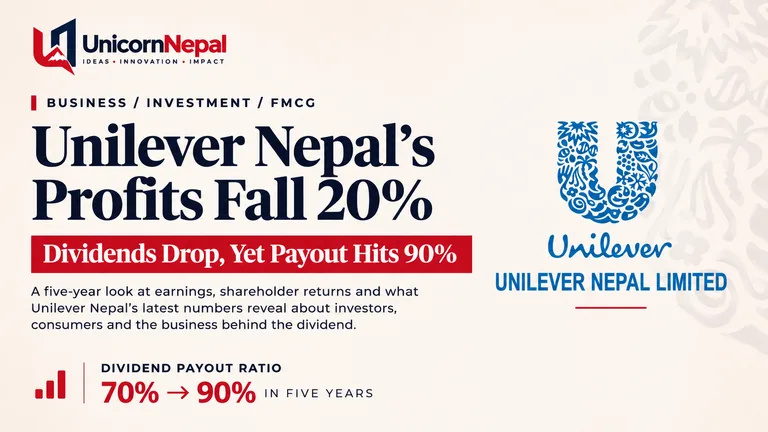
Unilever Nepal's Profits Fall 20%, Dividends Drop 16%, Yet Payout Ratio Hits 90%
After five years of increasingly generous shareholder distributions, Unilever Nepal has proposed a NPR 142 crore dividend despite declining annual earnings. Under Managing Director Amlan Mukherjee, the consumer-goods manufacturer is navigating shifting purchasing habits, rising costs and a changing balance between profits and shareholder returns.
Column ·Unilever Nepal's Profits Fall 20%, Dividends Drop 16%, Yet Payout Ratio Hits 90%
Unilever Nepal's Profits Fall 20%, Dividends Drop 16%, Yet Payout Ratio Hits 90%
After five years of increasingly generous shareholder distributions, Unilever Nepal has proposed a NPR 142 crore dividend despite declining annual earnings. Under Managing Director Amlan Mukherjee, the consumer-goods manufacturer is navigating shifting purchasing habits, rising costs and a changing balance between profits and shareholder returns.
Unilever Nepal has spent much of the past five years doing something investors generally appreciate: earning more money and returning an increasing proportion of it to shareholders.
But its latest financial results reveal an interesting divergence.
For FY2025/26, the manufacturer behind some of Nepal's most familiar household and personal-care brands reported approximately NPR 158 crore in net profit, a decline of 20% from the previous year's NPR 197 crore.
Its proposed cash dividend also declined, from NPR 1,842 to NPR 1,540 per share.
Yet the proportion of annual earnings earmarked for shareholders moved in the opposite direction.
Unilever Nepal's dividend payout ratio has reached approximately 90%, up from 86% a year earlier and around 70% five years ago.
The distinction is important. Shareholders are set to receive less money per share than last year, but a larger share of the company's current earnings.
The proposed distribution totals approximately NPR 141.8 crore, subject to shareholder approval.
For one of Nepal's most established multinational manufacturers, the figures offer a revealing picture of how profitability, consumer demand and shareholder distributions have evolved.
They also arrive as Unilever Nepal's latest quarterly results suggest sales are recovering, even while earnings remain sensitive to costs and product mix.
Five Years of Unilever Nepal: From Rising Earnings to a 90% Payout
Unilever Nepal's financial journey since FY2020/21 has been marked by a substantial improvement in profitability, followed by a more challenging latest year.
The company, established in 1992 as Nepal Lever Limited, operates as the Nepalese subsidiary of Hindustan Unilever, manufacturing and distributing consumer products across personal care, beauty and home care.
Its business includes brands familiar to Nepalese households, such as Lifebuoy, Lux, Dove, Sunsilk, Clinic Plus, Closeup, Pepsodent, Wheel and Surf Excel.
Under Managing Director Amlan Mukherjee, who began leading the company in April 2020, Unilever Nepal experienced a significant post-pandemic recovery.
In FY2020/21, operating revenue stood at approximately NPR 573 crore, with net profit of NPR 86 crore.
By FY2022/23, revenue had climbed to NPR 848 crore and net profit to NPR 183 crore.
The following two years brought a different pattern.
Operating revenue eased to approximately NPR 824 crore in FY2023/24 and remained almost unchanged at NPR 825 crore in FY2024/25.
But profits continued rising, reaching approximately NPR 196 crore and NPR 197 crore respectively.
That meant Unilever Nepal was becoming more profitable without generating comparable growth in sales.
Gross margins improved through a combination of lower input costs, efficiencies and changes in product economics, helping the company maintain earnings despite a softer revenue environment.
Shareholder distributions followed that performance.
The company's cash dividend increased from NPR 650 per share for FY2020/21 to NPR 1,215, NPR 1,580, NPR 1,714 and eventually NPR 1,842 for FY2024/25.
Over the same period, the proportion of annual earnings allocated to dividends increased from approximately 70% to 86%.
The latest year changed the direction of absolute earnings and dividends, but not the payout trend.
In FY2025/26, operating revenue declined approximately 4% to NPR 791 crore, while net profit fell to NPR 157.7 crore.
The board subsequently recommended NPR 1,540 per share, equivalent to a total proposed cash distribution of approximately NPR 141.8 crore.
Dividends fell 16.4%, but profits declined approximately 20.1%.
As a result, the proposed dividend represents nearly 90% of reported earnings.
The amount of annual profit not earmarked for that distribution narrowed from approximately NPR 27.6 crore in FY2024/25 to NPR 15.9 crore in FY2025/26.
These amounts are simplified calculations of annual earnings less the dividend attributable to each financial year. They are not the company's total cash holdings or accumulated retained earnings.
A high dividend payout ratio is not inherently unusual for a mature consumer-goods company, particularly one with established brands and relatively predictable operating requirements.
Nevertheless, Unilever Nepal's five-year progression provides an important measure of its evolving shareholder-return profile.
The company has steadily increased the proportion of profits distributed, even as the latest year brought a decline in earnings.
Behind the Margins: The Changing Nepalese Consumer
The latest results also offer insight into a wider story unfolding across Nepal's consumer market.
Unilever Nepal operates in categories where purchase decisions are influenced by household budgets, pricing, availability, brand preferences and competition.
Its portfolio includes everyday essentials, but consumers still have choices about which brands, product sizes and price points they prefer.
In its FY2023/24 reporting, the company disclosed a particularly revealing trend.
Sales volumes had declined approximately 9.1%, even as profitability improved.
The company benefited from softer commodity costs, savings initiatives and changes in product mix that helped support margins despite weaker physical sales.
That relationship became harder to maintain in FY2025/26.
The company's annual revenue declined approximately 4%, while net profit fell more sharply.
Management cited higher raw-material and packaging costs, competitive pricing conditions and consumers shifting towards more affordable products.
These pressures matter because consumer-goods companies must balance accessibility with profitability.
Passing higher costs on to customers can protect margins, but it can also affect demand when households become more price-sensitive.
Absorbing those costs can support sales volumes while reducing earnings per unit sold.
Unilever Nepal faces competition across several product categories from international brands and domestic manufacturers.
In personal and hair care, brands associated with Dabur, Procter & Gamble and other consumer-goods companies compete for household spending.
In laundry and household products, manufacturers such as Nepal's Gopal Soap Industries provide another competitive dimension.
These comparisons do not establish that Unilever Nepal is losing market share. Publicly available information does not provide a sufficiently detailed category-by-category market-share assessment.
What its own financial commentary does establish is that affordability, input costs and the changing mix of products purchased by consumers have become increasingly important.
The latest quarterly results add another layer.
In November 2026, Unilever Nepal reported approximately NPR 224 crore in first-quarter revenue for FY2026/27, an increase of around 12% from the corresponding period.
However, net profit declined approximately 16%, from NPR 30 crore to NPR 25.23 crore.
At first glance, that suggests stronger sales without a corresponding recovery in earnings.
But the underlying explanation is more nuanced.
The company reported higher material costs and an unfavourable product mix, alongside a NPR 5 crore contribution towards disaster relief following flooding in Bhotekoshi.
That exceptional contribution affected the quarter's reported profit. Excluding it, while allowing for associated tax effects, underlying profitability was considerably closer to the prior year's level.
The quarter therefore does not establish that Unilever Nepal's core profitability has deteriorated by the full reported 16%.
Instead, it highlights the factors investors will need to monitor: whether volume and revenue growth continue, how production costs develop, and whether the company can maintain margins while serving an increasingly price-conscious market.
For Nepal's wider economy, Unilever's financial performance offers a useful perspective on household consumption, although no single manufacturer's results can establish the direction of the entire consumer market.
Its November figures suggest demand has not disappeared. The question is how profitably that demand can be served.
Who Receives the NPR 142 Crore? Ownership, Royalties and Investor Returns
Unilever Nepal's shareholder structure gives its dividend policy an international dimension.
The company is 80% owned by Hindustan Unilever Limited, its Indian parent. Sibkrim Holdings holds 5%, while the remaining 15% is held by public shareholders.
At the proposed NPR 1,540 dividend per share, the NPR 141.8 crore distribution would be allocated approximately as follows:
Hindustan Unilever would be entitled to NPR 113.5 crore in gross dividends.
Sibkrim Holdings' share would amount to roughly NPR 7.1 crore.
Public shareholders would collectively be entitled to approximately NPR 21.3 crore.
These figures represent gross dividend entitlements before applicable taxes, assuming the proposed distribution is approved.
The arrangement reflects the economics of a multinational subsidiary with an established local manufacturing and distribution operation.
Unilever Nepal generates earnings in its domestic business, while its shareholders participate in those earnings according to their ownership.
The company's relationship with its international parent extends beyond dividends.
Historical audited disclosures also record royalty expenses associated with the use of Unilever trademarks, product formulations and intellectual property.
In FY2023/24, the company reported royalty transactions of approximately NPR 15.16 crore with Hindustan Unilever and NPR 3.16 crore with Unilever PLC.
These are distinct from dividends.
Royalty expenses arise from commercial arrangements for intellectual property and related rights, whereas dividends represent distributions to shareholders from profits available for appropriation.
They also should not automatically be interpreted as cash remitted during the same accounting period.
For investors, understanding both is important to assessing the financial relationship between the Nepalese operation and its international group.
There is another distinction that matters when evaluating Unilever Nepal's dividend announcement.
The proposed cash dividend is frequently expressed as 1,540%.
That percentage is calculated against the company's NPR 100 share face value.
It does not mean an investor purchasing shares at market prices will earn a 1,540% investment return.
At a market price of approximately NPR 48,500 per share in early November 2026, the proposed NPR 1,540 dividend implies a gross dividend yield of around 3.18%.
An investor's actual return depends on the purchase price, taxes, future distributions and changes in the share price.
The company's dividend policy must therefore be considered alongside its valuation and future earning capacity.
For FY2025/26, Unilever Nepal's financial position also showed combined cash and fixed deposits of approximately NPR 244 crore, down from around NPR 338 crore a year earlier.
Inventories increased from roughly NPR 109 crore to NPR 155 crore over the same period.
Those changes make working capital and cash generation relevant to understanding future shareholder distributions, though they do not by themselves establish a liquidity problem.
Nor does a 90% payout ratio imply the company has distributed 90% of all the resources available to it.
Unilever Nepal retains accumulated earnings and other assets, and its future investment capacity depends on cash flow, capital requirements and financial obligations—not simply the amount of one year's profit left after dividends.
For public shareholders, the latest results present two related observations.
The company has demonstrated an ability to generate substantial cash distributions over several years.
At the same time, its latest annual earnings have weakened, and the proposed dividend now represents a larger proportion of those earnings.
Whether revenue recovery translates into sustained profit growth will influence how that balance evolves.
For Unilever Nepal, the past five years illustrate the changing relationship between a mature consumer-goods business and its shareholders.
Annual profits rose from NPR 86 crore to a peak of approximately NPR 197 crore before declining to NPR 158 crore.
Cash dividends increased for several consecutive years before the latest reduction.
Yet the proportion of earnings allocated to shareholders continued climbing, reaching approximately 90%.
Meanwhile, the company's November 2026 results suggest sales are recovering as management navigates higher input costs, changing product preferences and competitive pricing.
The most revealing observation is not that Unilever Nepal is paying less in dividends. It is that the company is distributing a greater share of what it earns.
For investors, the next chapter will be shaped by the relationship between revenue growth, profitability and the cash available for future distributions.
For Nepal's consumer economy, it will offer another indication of how established brands adapt as household purchasing habits change.
And for Unilever Nepal, it marks a new phase in a familiar financial story: balancing the earnings generated today with the shareholder returns and business opportunities of tomorrow.